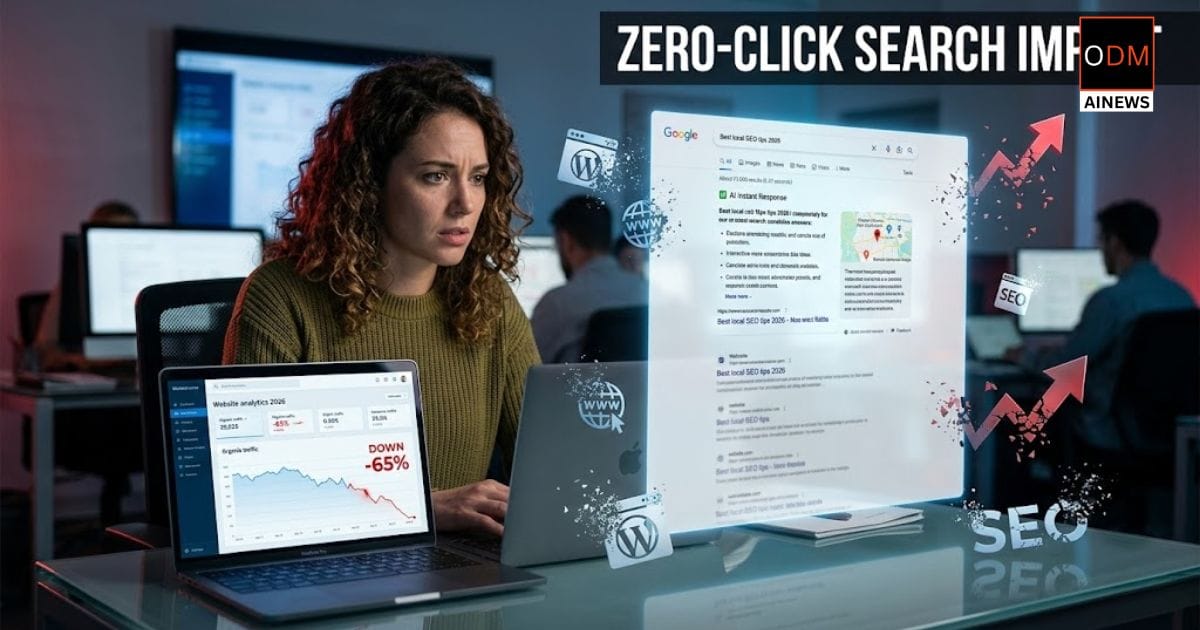
HubSpot lost between 70% and 80% of its organic search traffic. Not gradually, not quietly catastrophically, in the span of roughly eighteen months. And HubSpot is not a small blog with inconsistent publishing cadence. It is one of the most sophisticated content marketing operations on the internet, with thousands of pages built and maintained by professional SEOs. If it happened to them, it can happen to you and for many marketers, the data on zero-click search impact on organic traffic in 2026 suggests it already is. According to an analysis by KEO Marketing, 73% of B2B websites experienced significant traffic losses between 2024 and 2025, with an average year-over-year decline of 34%. Some sectors have seen organic traffic fall 15% to 64% since AI Overviews launched. News publishers have watched Google referrals drop 33% globally in the twelve months ending November 2025.
The question is not whether this is happening. It is what you do about it from here.
60%of all searches now end without any click to a website 77%of mobile searches end with zero clicks 61%drop in organic CTR when Google AI Overviews are present 34%average YoY organic traffic decline across B2B sites
What Is Zero-Click Search And Why It Has Exploded
A zero-click search is any query that resolves on the search results page itself, without the user clicking through to an external website. The answer appears directly inside a featured snippet, a knowledge panel, a local map result, or increasingly, an AI-generated summary and the user’s need is met before they ever leave Google’s ecosystem. This is not a new phenomenon. Google has been engineering it for years through Knowledge Graph and voice search. What’s changed in 2024 and 2025 is the scale and the mechanism: AI Overviews are now the primary engine driving zero-click behaviour, and they are expanding aggressively.
Semrush data shows AI Overviews appeared on 13.14% of all US desktop queries in 2025 more than double the figure from January of the same year. In specific categories, the presence rate reached as high as 32.76%. When AI Overviews appear, organic CTR falls from 1.62% to just 0.61%, according to analysis of 3,119 informational queries by Seer Interactive. And here is the detail that most reports bury: even queries without AI Overviews present experienced a 41% organic CTR decline between January 2024 and January 2025. Users are clicking less across the board, not just on the queries where AI intercepts them. The behaviour has changed, not just the SERP layout.
The commercial logic driving this is straightforward. Google’s business model is built on keeping users on Google properties long enough to serve them ads. Every query that resolves on-SERP is a query that doesn’t require a user to leave. Every AI Overview is a retention mechanism dressed as a convenience feature. This is not a conspiracy theory it is Google’s documented business incentive, and it explains why AI Overview expansion will continue accelerating regardless of publisher pressure.
The Data How Much Traffic Is Actually Being Lost
The traffic loss picture is more complicated than the headline numbers suggest, and understanding that complexity is essential to responding to it intelligently. Market-level organic traffic data from Graphite, reported by Search Engine Land in January 2026, shows US organic search traffic down just 2.5% year-over-year. That sounds manageable. It isn’t, because that number masks extreme redistribution.
| Sector / Content Type | Organic Traffic Change (2025–2026) | Primary Cause |
|---|---|---|
| B2B SaaS (informational) | –70% to –80% | AI Overviews dominate informational TOFU queries |
| News and publishing | –33% (Google referrals globally) | Zero-click and AI summaries replacing article reads |
| B2B websites (average) | –34% YoY average | Combination of AI Overviews and zero-click behaviour |
| E-commerce (headphones, apparel) | –11 to –23 percentage points click share | Paid ads doubled share; organic squeezed below 55% |
| Greeting cards / seasonal | –13 percentage points organic share | Growing total search volume but paid capturing gains |
| Top 10 authority sites | +1.6% growth | AI citation advantage compounds for dominant brands |
The distribution pattern matters enormously. The top 10 sites in most categories are growing approximately 1.6%, while sites ranked between position 100 and 10,000 are experiencing the sharpest declines. Organic search has always rewarded authority but AI has compressed that reward into a narrower band at the top while accelerating the erosion of everything beneath it. Mid-tier publishers and brands that once relied on steady long-tail traffic are the hardest hit, and those losses are structural, not cyclical.
Which Content Types Are Most Vulnerable
Not all content faces equal exposure. The most vulnerable category by a significant margin is surface-level informational content: how-to guides, definition articles, FAQ pages, and general explainers on topics that AI can answer accurately and completely without needing to cite an external source. This is precisely the content that dominated SEO playbooks for the previous decade. Broad keywords, high search volume, low difficulty the entire architecture of traffic-first content strategy. Google’s AI can answer “what is a sales funnel,” “how to write a cold email,” and “best practices for Instagram Stories” without ever pointing to your blog post. That traffic is not coming back.
Question-style and conversational queries are particularly exposed. BrightEdge confirmed that longer, conversational queries of eight or more words trigger AI Overviews far more often than short queries. Which means the long-tail keywords that were supposed to be easier to rank for and more intent-specific are now the exact queries most likely to be absorbed by AI summaries. The strategic premise of targeting long-tail conversational keywords has been partially inverted.
Which Content Types Still Survive And Earn Clicks
The picture is not uniformly grim. Certain content categories retain strong click-through rates because AI cannot fully replace the user’s need to visit a page. Transactional queries where a user intends to purchase, download, or book still generate clicks at meaningful rates because the action cannot be completed on the SERP. Navigational queries where a user is looking for a specific website are similarly protected. Highly localised queries involving current information like opening hours, menus, event listings, or real-time pricing still drive map pack and website clicks at healthy rates.
The most resilient content of all, however, is proprietary. Original research, first-party data, industry benchmarks, expert interviews, case studies built on client outcomes, and opinion-led analysis that expresses a defined and defensible point of view these are the content types that AI cannot summarise without citing you, because you are the source. If the data lives only on your website, AI must either reference you or ignore the data entirely. That’s a structural protection no amount of on-page SEO can replicate, and it is the single most important strategic insight for any content programme in 2026.
“The brands that will win in AI-driven discovery are the ones doing the fundamentals well: building real credibility, earning trusted external mentions, and writing for readers instead of algorithms. AI search has simply made it mandatory.” Search Engine Land, March 2026
Strategy 1 Build Brand Presence Inside AI Tools
The data contains one finding that should redirect every marketer’s attention immediately: brands cited in AI Overviews earn 35% more organic clicks than non-cited competitors on the same SERP. Cited sources in paid results fare even better, earning 91% more paid clicks. The penalty for invisibility in AI answers is steep. The reward for citation is disproportionate. This makes earning AI citations not a supplementary goal but the primary distributional objective of content strategy in 2026.
How to execute this
Build content that leads with a direct, specific answer to the user’s question within the first 150 words analysis by Averi.ai found that 44.2% of all LLM citations are pulled from the first 30% of text. Add proprietary statistics, named expert quotes, and structured definitions that AI systems can extract and attribute. Create an llms.txt file on your domain to help AI crawlers understand your site structure, and verify your robots.txt isn’t inadvertently blocking the ChatGPT-User, PerplexityBot, or Googlebot-Extended agents. Finally, treat your brand’s off-site reputation as a citation signal third-party mentions on Reddit, LinkedIn, and review platforms are part of the authority picture AI systems use when deciding which sources to cite.
Strategy 2 Invest in Email and Newsletter Traffic as a Primary Channel
The only traffic channel completely immune to zero-click search is the one that doesn’t pass through Google at all. Email newsletters deliver your content directly to a subscribed audience that has explicitly consented to receive it, bypass all SERP intermediaries entirely, and produce session quality that organic search increasingly cannot match. A reader who opens your newsletter and clicks through to a long-form piece is demonstrating purchase-adjacent intent the kind of high-engagement visit that converts at significantly higher rates than cold organic traffic.
The strategic reframe required here is treating your email list not as a secondary channel for distributing content already published on the blog, but as the primary publication surface. Write content that is exclusive to your list first. Reserve your most data-rich, most opinion-forward analysis for subscribers before it appears anywhere else. This builds list-switching costs a subscriber who knows your best material lands in their inbox before it goes anywhere else has a compelling reason to stay subscribed. And in an environment where organic traffic is structurally declining, an owned audience of 5,000 highly engaged subscribers is worth more than 50,000 monthly visitors who arrived via a Google query and left in 45 seconds.
Strategy 3 Optimise for Featured Snippets and SERP Dominance
Featured snippets are a double-edged instrument in the zero-click environment. Earning one can reduce clicks to your own site you’ve answered the question so effectively that the user has no reason to continue. But the alternative, in most competitive categories, is that a competitor earns the snippet and captures both the zero-click visibility and the residual branded awareness that comes from it. The strategic calculation strongly favours earning the snippet, particularly for queries adjacent to your core conversion terms.
The technical execution has become more specific. Paragraph snippets the most common format require a direct question as an H2 heading immediately followed by a two-to-four sentence answer that defines the concept clearly. List snippets require numbered or bulleted steps structured with process-specific language. Table snippets are triggered by comparative content with clear row and column headers. Position matters too: FirstPageSage’s May 2025 data shows position one now captures 2.1 times the clicks of position two, up from 2.0 times the year before. The gap between first and second position has widened. Getting to the top result is worth substantially more than it was twelve months ago.
Key insight: Google’s impression counting is inflating your Search Console metrics. When you appear in both an AI Overview and a traditional organic result for the same query, Google logs two separate impressions but users often click neither. One documented case showed impressions up 27.56% year-over-year while clicks dropped 36.18% and CTR fell from 5.98% to 3.35%, despite average ranking position actually improving. If your impressions are rising but clicks are flat or declining, you are almost certainly seeing this effect. Measure click volume and conversion rate, not impression share.
Action Plan for 2026
Marketers face a version of the zero-click problem that is simultaneously more severe and more recoverable than the global average suggests. More severe because mobile-first search behaviour puts most queries in the 77% zero-click mobile category by default. More recoverable because the structural advantages available to early-moving brands are genuine and underexploited.
Google AI Overviews are rolling out in world at a pace that trails the US by roughly two to three product cycles. That lag is a window not a permanent advantage, but a real one during which marketers can build citation authority, earn featured snippet positions, and establish brand presence inside AI tools before the competitive density of the US market arrives locally. Act with the urgency the US data demands, but use the timeline world’s market position still provides.
- Publish one proprietary data piece per quarter an survey, benchmark study, or industry analysis. Original data is the most citation-resistant content type available.
- Prioritise Google Business Profile optimisation immediately. With mobile zero-click at 77%, local pack visibility is one of the highest-intent surfaces left that still drives clicks.
- Build your email list before organic traffic declines make list acquisition expensive. The cost-per-subscriber rises sharply when organic traffic drops start while the economics are still favourable.
- Audit your Search Console immediately using the click-impression diagnostic: if impressions are rising while clicks are flat, you’re experiencing the double-counting effect. Recalibrate your KPIs around click volume and on-site conversion, not session count.
- Track your brand mentions inside ChatGPT and Perplexity manually every month. This is free, takes under an hour, and gives you a directional baseline before you invest in paid citation monitoring tools.
What this means for you
The zero-click search impact on organic traffic in 2026 is not a temporary disruption awaiting a platform fix it is the new structural reality of how people find information online, and it will intensify as AI Overviews expand, voice search deepens its penetration, and users increasingly get answers without ever leaving the SERP. The marketers who survive this shift are not the ones who optimise harder for the old metrics. They are the ones who accept that visibility and traffic have decoupled, that search is now an influence channel as much as a traffic channel, and that owned audiences email lists, community platforms, direct relationships are the only distribution assets that Google cannot gradually erode. Produce content no AI can summarise without citing you. Own your audience directly. Earn your place in AI answers before your competitors do. The brands that make these moves in early 2026 will look like geniuses by the end of it.