
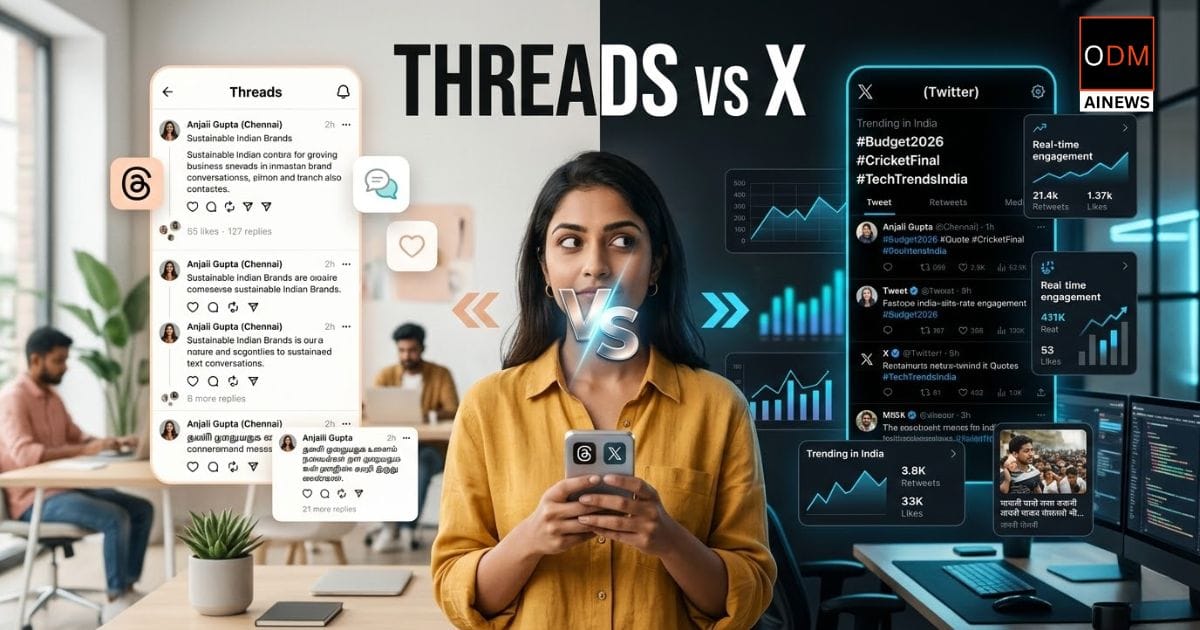
Threads crossed 141.5 million daily mobile active users on January 7, 2026 officially overtaking X’s 125 million on mobile, according to Similarweb. That single data point, published in TechCrunch, marks a milestone that most social media analysts had been projecting for the second half of 2026, not the first week of January. The Threads vs X race for marketer attention has reached its inflection point, and the implications are immediate for anyone still treating this as a “wait and see” decision. Both platforms are live, both have active ad ecosystems now, and they reward fundamentally different content strategies. Getting this choice right in March 2026 will shape your organic reach, ad spend efficiency, and brand authority for the next two years.
400MThreads monthly active users (Aug 2025) 570MX monthly active users (early 2026) 141.5MThreads daily mobile users (Jan 7, 2026) 125MX daily mobile users (Jan 7, 2026) 6.25%Threads median engagement rate 3.6%X median engagement rate
Current User Numbers What the Data Actually Shows
The user count debate between these two platforms requires more precision than most headlines offer. On monthly active users, X still leads: approximately 570 million globally against Threads’ 400 million as of early 2026. That’s a real gap. On daily mobile engagement, however, Threads has flipped the script 141.5 million versus 125 million, a lead it has been building since September 2025 according to Similarweb’s longitudinal tracking.
There are legitimate caveats to both sets of numbers. X is a private company and shares official figures infrequently its claimed 250 million daily active users is self-reported and not independently verified. Similarweb’s methodology estimates from a wide data pool rather than first-party analytics. Threads’ 400 million monthly active number comes from Meta’s own announcement in August 2025. Take all of these with the appropriate professional scepticism. What’s less disputable is the directional trend: Threads is growing at 127.8% year-over-year, while X’s mobile app usage is declining at 15.2% year-over-year. Trajectories matter as much as snapshots, and these trajectories have been consistent for over eighteen months.
One number that deserves more attention than it receives: nearly 20% of all Threads downloads have come from India, making it the single largest national source of Threads installs globally. For Indian marketers evaluating where to build their audience, that figure is not a footnote it is the central data point.
Audience Demographics Who Is Actually on Each Platform
The demographic profiles of the two platforms are diverging, and that divergence has direct consequences for which brands belong where. Threads skews younger and more gender-balanced. Over a third of all Threads users 35.8% in the US fall in the 18-to-24 age bracket. The platform’s integration with Instagram means its user base inherits Instagram’s cultural affinities: lifestyle, fashion, food, entertainment, sports, and creator-led content. It is a platform of opinions, conversations, and cultural moments rather than hard news and political commentary.
X’s audience is older, more male-skewed, and disproportionately concentrated in tech, finance, media, politics, and sports. It retains the highest concentration of journalists, political figures, financial analysts, and industry commentators of any social platform a fact that makes it uniquely valuable for specific professional contexts even as its total usage declines. X users still spend an average of 34 minutes per session on the platform, compared to approximately 5 minutes on Threads. That session depth is significant: it means X users are more immersed when they engage, while Threads users are engaging more frequently but more briefly.
For Indian marketers specifically, the audience overlap matters. Both platforms have strong Indian user presence, but Threads’ Instagram integration means it is effectively a continuation of India’s most visually engaged social audience. If your brand already performs well on Instagram, Threads offers the most direct extension of that existing community.
Content Formats What Each Platform Actually Rewards
These are not interchangeable platforms in different skins. The content that performs on each reflects the algorithmic priorities of each platform, and those priorities are genuinely distinct.
On Threads, the algorithm is conversation-first. It surfaces content with high reply rates over content with high like counts. Posts that ask direct questions, state a provocative opinion, or share a surprising observation consistently outperform polished, promotional content. Employee advocacy is disproportionately powerful here companies that encourage employees to share branded content from personal accounts are seeing 10 to 15 times the organic reach of brand account posts, according to analysis by Digital Applied. Photos outperform link posts on median engagement. Text-first creative works. The platform rewards accounts that participate in replies rather than broadcasting into the void.
On X, real-time relevance drives distribution. Content tied to breaking news, live events, and trending conversations earns disproportionate reach. The platform still activates uniquely during major cultural and political moments sports finals, elections, product launches, controversies in ways that Threads has not yet fully replicated. Long-form posts (up to 25,000 characters for X Premium subscribers) and threaded essays perform well for thought leadership in professional verticals. Polls, quote posts, and content that drives retweet behaviour are the platform’s native amplification mechanics.
Organic Reach Which Platform Is More Generous in 2026
This is where the case for Threads becomes most compelling for resource-constrained marketing teams. Threads is, right now, at the stage in its algorithmic maturity that Instagram was in approximately 2015 before the feed became saturated, before organic reach began its long structural decline, before ad spend became the primary growth lever. A brand account with 5,000 followers on Threads can realistically reach 500,000 users with the right content. That ratio is no longer achievable on Instagram, Facebook, or X. According to Rival IQ’s social benchmarks, engagement rates dropped across every major platform in 2025 Facebook fell 36%, Instagram 16%, and X took the sharpest hit at 48%. Threads moved the other way.
X’s organic reach has compressed significantly. Its feed now surfaces substantial Grok AI-generated content, which many users report has degraded the signal-to-noise ratio of their timelines. Combined with declining daily mobile usage, the organic reach per post on X has weakened and for brands that don’t operate in the specific verticals where X’s power user base remains concentrated, the returns are increasingly thin.
“From an operational efficiency perspective, is it not much better to be investing 30 minutes a day building organic reach to people that actually see it, instead of pouring money into Instagram ads that don’t deliver? The opportunity for growth on Threads is wide open, but rest assured, it won’t stay that way.” NoGood Marketing Analysis, February 2026
Advertising Options Threads Ads vs X Ads
This comparison has changed dramatically since January 21, 2026, when Meta officially launched Threads advertising to all advertisers worldwide. For the first time, marketers can now run paid campaigns against Threads’ 400 million monthly users through Meta Ads Manager the same interface, the same targeting infrastructure, and the same measurement tools they already use for Instagram and Facebook.
| Threads Ads | X Ads | |
|---|---|---|
| Ad platform | Meta Ads Manager Familiar interface | X Ads Manager (rebuilt post-acquisition) |
| Current CPM | ~$5–$10 (early market) Lower cost now | ~$10 (established market) |
| Targeting depth | Meta interest + Instagram behaviour data Wins | Interest, keyword, follower lookalike |
| Ad formats | Text, image, video (feed only currently) | Text, image, video, carousel, app install More formats |
| Brand safety | High Meta content moderation Wins | Ongoing concerns; reduced moderation since 2022 |
| Performance focus | Awareness and engagement (no conversion bidding yet) | Full-funnel including website conversions More mature |
| Projected revenue 2026 | $11.3B (Evercore ISI forecast) | Declining major advertisers paused spend |
The most important strategic insight from this comparison: Threads ads are currently in their cheapest window. Duolingo’s early testing showed a cost-per-follower 60% lower than Instagram, with engagement rates four times higher. Those figures will normalise as more advertisers enter the auction. The brands that build their targeting data, creative templates, and audience learning on Threads in Q1 and Q2 2026 will be paying substantially lower rates than those who enter the platform in Q4 when CPMs have risen to reflect competitive demand.
India-specific advantage: Just under 20% of all Threads downloads globally have come from India. Combined with Threads’ $5–$10 CPM in the early ad market, Indian marketers running Threads ads right now are reaching one of the world’s fastest-growing platform audiences at acquisition costs that will not be available six months from now.
Brand Engagement Rates What the Numbers Say
Threads’ median engagement rate of 6.25% versus X’s 3.6% a 73.6% higher interaction rate is the single most compelling data point for performance-oriented marketers evaluating where to invest organic effort. That figure, sourced from a November 2025 analysis by inBeat Agency and corroborated by NoGood’s February 2026 benchmarks, represents real interactions per impression. Not follower counts, not vanity metrics actual replies, reposts, and profile visits that signal genuine audience attention.
The caveat worth acknowledging is session depth. X users spend 34 minutes per session against Threads’ approximately 5 minutes. When X users engage, their engagement occurs in a more immersive context they are more likely to read through a thread, click a link, or follow up with a reply over time. For content designed to spark extended dialogue or drive traffic to external destinations, X’s engaged minority may outperform Threads’ larger but more transient audience depending on your specific objectives and vertical.
Which Industries Perform Better on Each Platform
| Industry / Brand Type | Recommended Platform | Reason |
|---|---|---|
| D2C lifestyle, fashion, beauty, food | Threads | Instagram audience crossover; visual + conversational content works |
| Fintech, crypto, investing | X | Financial power users concentrated on X; real-time market commentary culture |
| Media, news, journalism | X | Still primary platform for journalists and editors; breaking news amplification |
| Sports brands and athletes | Threads | Sports leagues migrating to Threads; celebrities and athletes building presence |
| B2B SaaS and tech | Both | X for industry commentary; Threads for founder/employee brand building |
| Entertainment and pop culture | Threads | Gen Z majority; celebrity culture embedded via Instagram graph |
| Political commentary, advocacy | X | Threads actively de-prioritises political content; X remains the arena |
| Healthcare, wellness, fitness | Threads | High engagement rates for health content; Instagram health community crossover |
| Indian regional brands and SMBs | Threads | India is Threads’ largest download market; early organic reach advantage |
One category worth calling out directly: brands in media and news that have been contemplating a Threads migration should note that Threads has made a deliberate algorithmic decision to de-prioritise political and hard-news content in favour of lifestyle, culture, and entertainment. This is not a temporary state it reflects Meta’s institutional commitment to keeping Threads brand-safe and commercially attractive to advertisers. If your content strategy is built on political commentary, regulatory news, or breaking-news coverage, X remains the more relevant platform regardless of its declining overall usage.
The Recommendation for Marketers in 2026
The Threads vs X decision for marketers in 2026 does not resolve cleanly to one winner it resolves to a strategic allocation question. For the vast majority of consumer brands, lifestyle businesses, D2C companies, and Indian SMBs, Threads deserves the majority of your organic social investment right now, and a meaningful portion of your experimental paid budget. The engagement rates are superior, the organic reach is in a generosity window that will not last, the advertising costs are at their lowest point, and India is already the platform’s number-one download market. The early-mover advantage is real and documented WebFX data shows early platform adopters see 30 to 50% faster follower growth than late joiners. That window is not permanently open. For B2B brands, fintech, media, and anyone whose audience is concentrated in X’s professional power-user base, maintain your X presence the session depth and vertical concentration make it irreplaceable in those contexts. Build on both for awareness. Invest for growth on Threads while the economics still favour you.
Your Threads starter plan
- Post 3 to 5 times per week consistency matters more than volume on the algorithm
- Lead every post with a direct question or a provocative, specific statementReply to every comment in the first hour early engagement triggers broader algorithmic distribution
- Enable employee advocacy: personal accounts reach 10 to 15x more users than brand accounts on the same content
- Request Threads ad access through Meta Business Suite and begin with $500 to $1,000 in engagement-optimized spend to build audience data before CPMs rise
- Track replies and profile visits, not just likes these are the signals Threads’ algorithm uses to decide your next post’s reach