
The Data Makes an Uncomfortable Argument
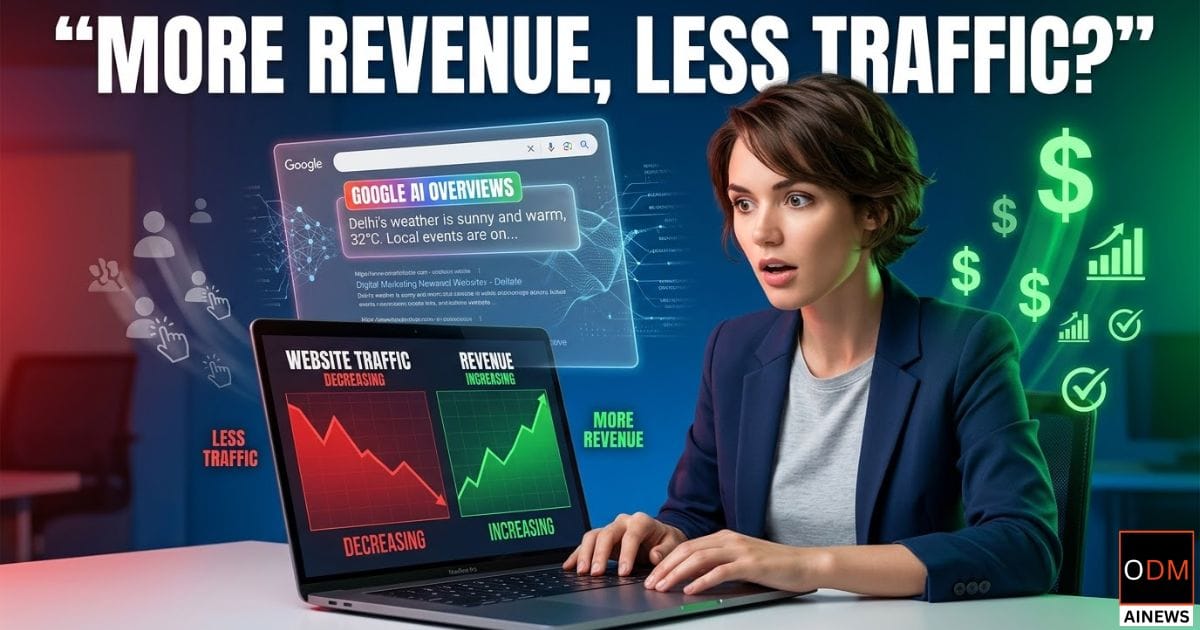
You can rank number one on Google, watch your click-through rate fall 61%, and still generate more revenue than you did a year ago. That is not a paradox it is what the Google AI Overviews revenue impact 2026 data is actually showing for brands cited inside AI-generated answers. AI traffic converts at 14.2% compared to Google’s 2.8%. A five-fold difference in conversion rate means you need far fewer visitors to produce the same business outcome. The problem is that most analytics dashboards aren’t set up to show you this. Your organic traffic chart looks like a crisis. Your revenue might not be.
This is the central tension in search right now, and it doesn’t resolve cleanly in either direction. Publishers relying on pageview-based ad revenue are being hit hard and legitimately. E-commerce and service businesses with strong brand authority are, in some cases, benefiting from the same change that is hurting publishers. The outcome depends almost entirely on whether your brand is being cited or ignored when Google assembles its AI answer.
What the Data Shows Lower Clicks, Higher Intent
BrightEdge data covering February 2025 through February 2026 shows Google AI Overviews grew 58% and now trigger on 48% of all searches. That is close to every second query on Google producing an AI-synthesised answer before a user sees a single organic result.
Seer Interactive’s September 2025 study, which tracked 25.1 million organic impressions across 42 organisations from June 2024 through September 2025, found that organic CTR fell from 1.76% to 0.61% for queries where an AI Overview appeared. That is a 65% reduction in click-through rate at the query level. Ahrefs’ December 2025 analysis found that AI Overviews reduce CTR for position-one content by 58%.
The click story is grim. The conversion story is different. When a branded result is cited within an AI Overview, CTR for that brand can actually increase. The citation itself functions as an endorsement, driving higher-quality clicks from users who have already been pre-qualified by the AI summary. Cited brands in AI Overviews see 35% higher organic CTR and 91% higher paid CTR compared to non-cited brands on the same queries. The user arriving after reading an AI Overview about your category is not the same user who clicked a keyword-matched blog post in 2022. They already know who you are and roughly what you do. They are arriving to decide.
Why AI Overviews Convert Better Despite Less Traffic
The mechanism is intent compression. Traditional search funnels spread buyer intent across dozens of touchpoints informational queries, comparison queries, branded queries, direct navigation. AI Overviews collapse several of those stages into one interaction. When prospects research a category using Google AI Overviews, the conversion happens before they ever click through to a site. The prospect who reads an AI Overview about a category and sees a brand recommended arrives dramatically more qualified than someone who clicked a keyword-optimised blog post.
With Google now delivering answers directly on results pages, decision cycles are shorter. Businesses have a narrower window in which to influence decisions later in the buyer journey. Visibility at the first point of contact has become more important than it has ever been.
The counterargument is fair and worth stating plainly. Google claims AI Overview clicks are of higher quality, but publishers can’t verify these claims without access to comparative engagement data. Google hasn’t provided specific metrics defining “higher quality.” Lily Ray, VP of SEO Strategy and Research at Amsive, has been direct about the quality control problem on Google’s end: the AI Overviews feature has surfaced misinformation and inaccurate results in documented examples since launch. Higher conversion rate on cited clicks does not fix a content ecosystem where the AI is sometimes citing unreliable sources. The two problems co-exist.
Which Industries See the Biggest Revenue Lift
The benefit is not evenly distributed. Adthena’s analysis across six major industries from late December 2025 to January 2026, covering more than five million ads, found that healthcare and financial services see informational AI Overviews that act as intent filters satisfying low-intent users before they reach a paid link, while protecting ad spend by removing users who were unlikely to convert anyway.
Telecom, technology, and retail face a different problem: AI Overviews in these categories are dominated by comparison content. When Google provides a side-by-side analysis at the SERP level, it satisfies the research phase before the user reaches any brand’s ad or organic result. For brands with strong enough authority to be the one cited in that comparison, the result is a high-intent referral. For everyone else, it is a lost opportunity.
Travel, home services, and local businesses show a different pattern. Travel AI Overview growth mirrors a broader consumer behaviour shift: travellers increasingly use conversational AI search to plan trips, compare destinations, and evaluate logistics. Brands in these categories that appear as cited sources for destination or comparison queries are capturing research-stage attention at the moment of highest brand influence before a booking decision is made.
How to Get Your Brand Featured in AI Overviews
There is no guaranteed path. That needs to be stated upfront. AI Overview citations are probabilistic, not deterministic. The BrightEdge citation data, combined with Google’s published guidance, points to content and technical practices that increase the probability of being cited, but nothing guarantees inclusion.
What the data consistently shows: content that directly answers a specific question in the first 50–70 words of an article is extracted and cited more frequently than content that buries the answer deep in the body. Pages that consistently appear in AI Overviews use question-based headings, provide concise answers at the beginning of each section, and follow a logical, scannable format. This structure helps AI systems extract meaning efficiently.
AI Overviews reward clarity and topical relevance more than keyword placement. Google also evaluates how consistently a topic is covered across a website, which means isolated strong articles matter less than a coherent cluster of related content.
Entity authority matters too. Brands with consistent messaging, verifiable expert authorship, and positive reputation signals across the web appear more frequently in AI-generated answers than brands that rank well on keywords alone. This is where SEO and brand strategy have finally converged into the same job.
Content Format That AI Overviews Prefer
Short declarative answers win. Long preambles lose. If your article starts with three paragraphs of context before reaching the actual answer to the query in its headline, Google’s AI system will skip to a competitor who led with the answer.
The structure that works: a direct answer to the query in the opening paragraph (50–70 words, no qualification, no throat-clearing), followed by depth that earns the citation. Think of it as writing for two audiences simultaneously the AI system skimming for an extractable answer, and the human reader who wants the full explanation after they arrive.
FAQ sections are particularly effective because they match the question-answer structure that AI extraction favours. Healthcare and financial services see high rates of FAQ-type content in their AI Overviews 54% FAQ in financial services suggesting that structured Q&A content is a reliable citation candidate in trust-sensitive categories.
Schema Markup for AI Overview Visibility
Schema markup does not guarantee an AI Overview citation. It does make your content easier for Google’s systems to parse, attribute, and verify which removes friction in the citation decision.
The most relevant schema types for AI Overview eligibility are FAQPage (for Q&A content), HowTo (for process-oriented articles), Article with author markup (for E-E-A-T attribution), and Organisation with sameAs properties that link your brand entity to Knowledge Graph entries. That last one matters more than most SEO guides acknowledge. If Google can confirm that your brand entity is the same entity mentioned across multiple authoritative sources, it has stronger grounds to cite your content as authoritative. Without clear entity disambiguation, even strong content can be attributed to a generic topic cluster rather than your specific brand.
Measuring AI Overview Impact on Revenue
The measurement problem is real, and it is arguably more serious than the traffic problem. When prospects research using Google AI Overviews, the conversion can happen before they ever click through to a site making it invisible to standard analytics.
The new measurement framework requires tracking Citation Rate (how often AI cites your brand in relevant queries) and AI-Sourced Pipeline (revenue from AI-referred leads), using GA4 custom segments for AI referral sources and fractional attribution models to capture AI-influenced conversions that completed through a different channel.
Standard Google Search Console does not directly report AI Overview citations. Platforms including BrightEdge AI Catalyst, Semrush, and Ahrefs have developed AI Overview tracking features that monitor which queries trigger AI Overviews and whether your content appears as a cited source. None of these tools are perfect. Together, they give you a workable picture of citation share versus competitors which is what actually matters for revenue forecasting in an AI search environment.
Strategy for Indian E-Commerce and Service Businesses
Google’s AI Overviews reach approximately 2 billion monthly users inside Google Search as of July 2025, powered by Gemini. In India, Gemini leads the AI chatbot market with 52% of AI chatbot downloads. That structural advantage means Indian users are disproportionately likely to encounter Gemini-powered AI Overviews when searching on Google making citation in those answers a higher-value target for Indian brands than it might be in markets where AI search adoption is slower.
For Indian e-commerce brands, the category split matters. Transactional product queries “buy running shoes under ₹3,000” still trigger AI Overviews far less frequently than informational queries. The opportunity sits in the research layer: “best running shoes for flat feet,” “how to choose a mattress,” “which laptop is best for college students.” These queries trigger AI Overviews regularly, and the brands cited in those answers are getting pre-qualified buyer attention before any paid ad or organic listing.
For service businesses legal, financial, health, education the path is clearer. FAQ-structured content answering specific, common client questions in direct language, published under named expert authors with verifiable credentials, consistently outperforms generic service pages in AI Overview citation rates. The investment required is real editorial work, not technical optimisation. That is a constraint for smaller teams, but it is also a moat. The brands willing to do it build citation authority that competitors can’t replicate by spending more on ads.
What This Means for You
The Google AI Overviews revenue impact 2026 story is not about traffic declining. It is about the relationship between visibility and revenue becoming more direct, more qualitative, and significantly harder to measure using the dashboards most teams built in 2019. Fewer but better visitors convert at higher rates. Citations function as endorsements. Brands that earn those citations get pre-qualified buyers. Brands that don’t get bypassed at the most consequential moment in the decision process.
The adjustment isn’t complicated, but it requires discipline: structure content for extraction, build entity authority, track citation rate alongside traffic, and stop optimising for click volume on queries where the AI is already answering the question. Reframe what a successful search performance looks like because the old frame is measuring a world that no longer exists.