
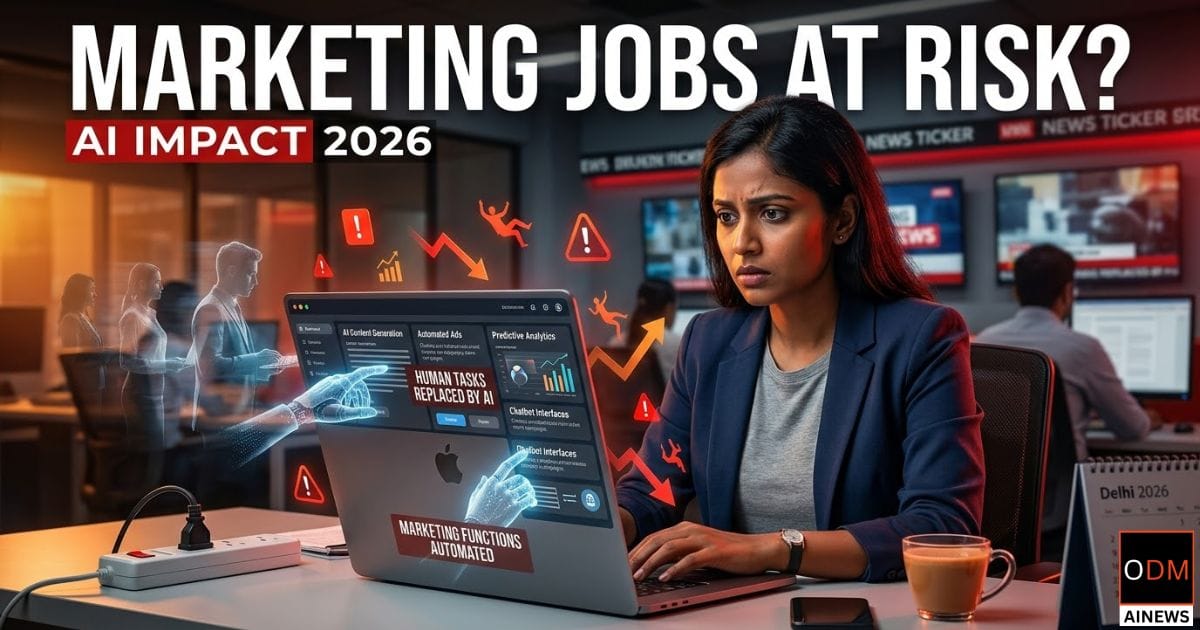
The Report That Actually Used Real Data
Three years after ChatGPT launched, almost every study on AI job displacement had the same flaw: they measured what AI could theoretically do, not what it was actually doing at work. Anthropic researchers Maxim Massenkoff and Peter McCrory fixed that. Their March 2026 paper, “Labor Market Impacts of AI: A New Measure and Early Evidence,” tracked real Claude usage across professional contexts, mapped those tasks to 800 occupations, and asked a different question: not capability, but observed deployment. The result is the closest thing we have to a ground-truth measure of AI marketing jobs at risk India 2026 and globally and the answer is more nuanced than most headlines suggest.
The central finding is a gap. Computer and Math occupations showed 94% theoretical AI exposure against only 33% observed. The gap between what AI can do and what organisations have actually deployed is consistently 50 to 65 percentage points. That gap is not permanent. It is closing. And the closing rate, not the current level, is what determines who has time to adapt.
What Anthropic’s Economic Impact Report Actually Found
Tasks rated as fully feasible for an LLM alone account for 68% of observed Claude usage, while tasks rated as not feasible account for just 3%. That tells you the AI is already performing the easy white-collar work summarising, drafting, classifying, formatting. What it can’t yet do reliably is the work requiring persistent judgment across ambiguous, relationship-dependent contexts. Marketing has both kinds of tasks inside it.
Workers in the most exposed occupations have not become unemployed at meaningfully higher rates than workers in jobs considered AI-proof. The unemployment signal is flat. But the hiring signal is different. A 14% hiring slowdown for workers aged 22 to 25 in exposed occupations is the most actionable early signal from the data. Companies aren’t firing people. They are quietly hiring fewer entry-level replacements. For young Indians entering the marketing workforce in 2026, that is a more immediate problem than redundancy.
The paper names the scenario everyone in the knowledge economy should be thinking about: a “Great Recession for white-collar workers.” The researchers note that a comparable doubling of unemployment in the top quartile of AI-exposed occupations from 3% to 6% would be clearly detectable in their framework. It hasn’t happened yet. The question is whether it will and how fast.
Which Marketing Roles Are Most at Risk
Computer Programmers rank first at 75% observed task coverage, followed by Data Entry Keyers at 67% and Customer Service Representatives at around 65%. Writers and Authors also appear in the top ten. In marketing terms, this maps directly onto the roles that carry the highest volume of repeatable, screen-based output with low contextual complexity.
Generic content writers producing SEO articles without strategic input, writing ad copy variations, creating social media captions at volume are the clearest marketing category in the firing line. Not because the work disappears, but because one marketer with AI tools now produces what previously required three writers without them. The role doesn’t vanish; the headcount does. The fresher salary for content writing roles in India in 2026 is ₹2–3.5 LPA, which tells you everything you need to know. Companies are paying the minimum for that role.
Manual SEO task execution link building outreach at scale, basic keyword clustering, metadata writing sits in the same exposure category. So does email campaign scheduling, social posting, and basic performance reporting. These are automatable. Many of them are already automated. The roles built primarily around executing them are structurally fragile.
Which Marketing Roles Are Safe and Growing
The Anthropic data is explicit: the least exposed occupations tend to require physical abilities or persistent human judgment across ambiguous, relationship-dependent contexts. In marketing, that translates to roles where the output cannot be separated from the person producing it.
Brand strategy, campaign architecture, client relationship management, community management, influencer partnerships, and conversion rate optimisation all require the kind of contextual judgment that AI augments but can’t replace. Content Strategist roles are growing 30% annually. AI-focused marketing roles are seeing a 40% increase in demand. Marketing automation management designing workflows, not just running them is up 10% year-on-year in job postings.
Marketing professionals with AI skills are projected to see salary increases of 20 to 30%, and in marketing and sales specifically, applied AI skills can trigger average pay bumps of around 43%, with senior specialists earning up to $250,000 in total compensation. The salary split between marketers who work with AI and those who work around it is widening every quarter.
India-Specific Job Market Data
India’s digital advertising market reached ₹49,000 crore in FY2025, growing 20% year-on-year. The industry is projected to maintain 25–30% CAGR through 2031 in India, creating consistent demand for SEO, performance marketing, content, analytics, and AI marketing roles. Digital now commands 44% of total Indian ad spend, having overtaken television.
Unemployment rates in digital marketing stand at 2.6–3.8% in India, well below the national average. The sector is not contracting. But it is bifurcating. Positions requiring only basic task execution see salary stagnation, while roles demanding AI proficiency alongside marketing expertise command premium compensation.
The hiring slowdown for young, entry-level workers that Anthropic identified in the US is visible in India too, specifically in generalist agency roles. 69% of companies in India struggle to find specialised digital marketing talent while simultaneously reducing intake for generalist positions. The shortage is real; it just doesn’t include the roles that are easiest to automate.
What Skills Protect You from AI Displacement
The Anthropic report draws a line between tasks AI performs and tasks that require sustained, contextual human judgment. For marketers, the skills that sit clearly on the safe side of that line are: campaign strategy and media planning, data interpretation and attribution analysis, client counselling and stakeholder management, brand voice development, and community management.
The salary difference between a content writer and a content strategist in India is ₹3 LPA versus ₹10–14 LPA. The strategist isn’t doing different work in terms of subject matter they’re doing it at a level of contextual judgment that resists automation. That gap will widen, not close.
Prompt engineering is a real skill, but it is not a moat on its own. It commoditises quickly. The durable combination is domain expertise genuine understanding of marketing mechanics, consumer psychology, and channel dynamics layered with AI fluency. One without the other produces diminishing returns. Both together produce a professional that is significantly harder to replace than either alone.
How Marketing Agencies in India Are Restructuring
The restructuring is already visible at mid-size performance marketing agencies in Mumbai, Bangalore, and Delhi. Output-based roles content production, basic SEO, social scheduling are being absorbed into smaller teams using AI tooling. The headcount reduction isn’t dramatic quarter-to-quarter. It’s quiet: positions that open up through attrition aren’t being refilled.
What agencies are actively hiring for is the inverse: account strategists who can run AI-assisted execution themselves, data analysts who can interpret attribution models across increasingly complex media mixes, and AI workflow designers who can build and maintain automated content and reporting systems.
The agency structure is compressing. A team that ran 12 people for a mid-size client three years ago might now run that account with six people and AI tools producing the operational layer. The six remaining people are doing more senior, more consequential work which is either an opportunity or a displacement, depending entirely on where you sit in the original 12.
AI as a Collaborator, Not a Replacement
The Anthropic researchers are careful about their own findings. They note that economists’ track records when it comes to predicting occupational change is poor previous research found about a quarter of US jobs were susceptible to offshoring, but a decade later, most of those job categories had seen healthy employment growth. The history of displacement predictions is mostly a history of overestimation.
What the data shows is that AI is a productivity accelerant in marketing, not a workforce eliminator at least right now. A performance marketer using AI tools for creative testing, audience segmentation, and copy generation is materially more productive than one who isn’t. That productivity advantage doesn’t translate into fewer marketing jobs if the market for marketing services expands at the same pace as AI adoption. And so far, in India, it is.
The risk is not mass displacement. The risk is a two-tier profession: one tier that uses AI to produce more sophisticated work at higher value, and another tier that competes on cost for automatable tasks in a market where the floor keeps dropping. Which tier you’re in is a choice you make now, not later.
Action Plan for Indian Marketing Professionals
The Anthropic data points to one practical framework: audit your own task exposure. Write down the ten tasks you perform most frequently in your current role. For each one, ask whether a well-prompted AI system could produce a comparable output in under five minutes. If the answer is yes for more than six of the ten, your role is structurally exposed not immediately at risk, but exposed to the kind of quiet headcount reduction that doesn’t show up in unemployment data until it’s already happened.
The upgrade path is specific, not generic. If you’re a content writer, the target is content strategist: add SEO research, performance analytics, content architecture, and editorial judgment to your skill set. The transition takes three to four months of focused work and more than triples your salary ceiling. If you’re a social media executive, the target is community management or paid social strategy both require human relationship judgment that AI consistently struggles with. If you’re in paid search, the target is cross-channel attribution and media strategy, where the AI handles bid management but the human decides where to play.
The most demanding digital marketing skills in India in 2026 are performance marketing across Meta and Google Ads, marketing automation, data analytics, and community management. All of them share the same characteristic: strategy drives the execution, not the reverse.
One more thing worth stating plainly. The AI marketing jobs at risk India 2026 conversation tends to attract either panic or dismissal. The Anthropic data supports neither. It supports urgency specific, skill-directed urgency from professionals who want to be in the growing tier of this industry, not the stagnating one.
What This Means for You
Anthropic built this framework specifically to catch disruption before it becomes obvious in unemployment statistics. The fact that the signal is small now doesn’t mean it stays small. The 14% hiring slowdown among young workers in exposed fields is the canary. It’s worth taking seriously.
The Indian marketing workforce has one genuine structural advantage in this transition: the market is growing fast enough that AI-fluent marketers are in short supply even as generalist positions thin out. That window won’t stay open indefinitely. The professionals who use it to build specific, judgment-intensive skills rather than waiting to see how the disruption plays out will find themselves on the right side of the bifurcation that is already underway.