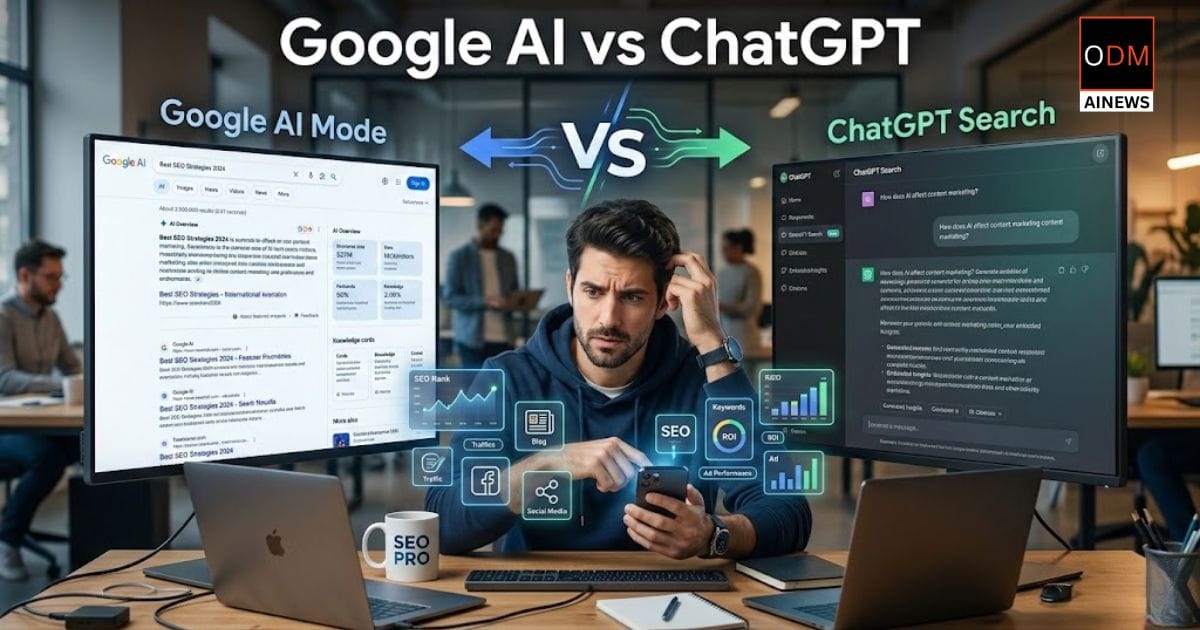
India now accounts for 9.42% of ChatGPT’s global traffic second only to the United States. Meanwhile, Google’s AI Mode is driving a 10% increase in search usage for queries it handles, specifically in its biggest markets: the US and India. Two AI giants, one country, one enormous question for every marketer working in the subcontinent. The Google AI Mode vs ChatGPT Search debate is no longer academic. Both platforms are live, both are actively shaping how Indian users discover information and brands, and they work in fundamentally different ways ways that demand different strategies, different content architectures, and different measurement frameworks.
Which one should you prioritise? The answer, as always, depends on what you’re trying to accomplish. But the data available in March 2026 is specific enough that we no longer have to guess.
900MChatGPT weekly active users globally 9.42%India’s share of ChatGPT global traffic 1B+Google AI Overviews monthly users 10%Search usage uplift from Google AI Mode
What is Google AI Mode? Features Explained
Google AI Mode is Google’s most ambitious reimagining of search since PageRank a conversational, Gemini-powered interface that sits above traditional results and handles complex, multi-part queries through what the company calls a query fan-out technique. When you ask AI Mode something nuanced, it doesn’t issue a single search. It breaks your question into subtopics, runs multiple searches concurrently, synthesises the results, and delivers a structured answer with source citations all within seconds.
The platform launched publicly in the US in early 2026 and is now powered by a custom version of Gemini 2.5, Google’s most advanced model to date. It includes Deep Search a feature capable of issuing hundreds of searches simultaneously to produce what Google describes as “expert-level, fully-cited reports” in minutes. For complex research tasks, this is genuinely impressive in practice. Canvas, Google’s workspace for drafting, organising, and converting research into documents or apps, rolled out to all US users in early March 2026 and is also part of the AI Mode experience.
The most significant addition as of mid-March 2026 is Personal Intelligence now expanding across AI Mode, the Gemini app, and Gemini in Chrome. This feature connects your Google apps (Gmail and Google Photos initially, with more to follow) to deliver responses that incorporate personal context: your email confirmations, past purchases, travel bookings, and calendar events. It’s opt-in, and Google has been careful to emphasise that it doesn’t train models on your inbox. But the practical implication is striking: AI Mode, for users who enable it, becomes a search engine that actually knows you. This is currently available to Google AI Pro ($19.99/month) and AI Ultra ($249.99/month) subscribers in the US, with broader rollout anticipated.
What is ChatGPT Search? How It Works
ChatGPT Search, launched in October 2024 and now available to all ChatGPT users including free-tier accounts, is OpenAI’s answer to the real-time web access problem that plagued earlier versions of the platform. Built on a fine-tuned version of GPT-4o with reasoning enhancements distilled from the o1 model, it combines ChatGPT’s conversational intelligence with live web retrieval through third-party providers including Microsoft Bing, plus direct content feeds from media partners: Reuters, the Associated Press, the Financial Times, and others.
The experience differs from Google AI Mode in one important structural way: ChatGPT Search is embedded within a conversational interface that carries context across an entire session. You can ask a question, get an answer with citations, follow up with a related question that builds on the previous context, ask for a comparison, request a summary, and have all of that emerge in a single coherent thread. Google AI Mode offers follow-up questions too, but ChatGPT’s multi-turn depth is more natural and more capable for complex research workflows.
Critically, ChatGPT Search is now the entry point for a platform with 900 million weekly active users processing 2.5 billion daily prompts. It is not a niche power-user feature. It is the default way hundreds of millions of people interact with information and for Indian users, who represent the platform’s second-largest national audience, it is increasingly the first destination for product research, brand discovery, and professional queries.
Speed, Accuracy, and Citation Comparison
The performance differences between the two platforms are real, documented, and strategically important for any marketer trying to understand where their brand needs to appear.
| Dimension | Google AI Mode | ChatGPT Search |
|---|---|---|
| Response speed | ~0.3 sec (Google index advantage) Wins | 6–24 hr content lag on some queries |
| Content freshness | Near real-time Wins | Strong for major sources, gaps elsewhere |
| Citation accuracy | 99.5% of sources from top-10 organic results | Only 14% overlap with Google top-10 Different pool |
| Citation rate | 54.5% match with top organic URLs | 62% of complex questions fully cited |
| Hallucination risk | ~9% of AI summaries have errors | Higher 84% accuracy for current info Google more accurate |
| Multi-turn depth | Good, improving | Superior conversational continuity Wins |
| Source transparency | Hover previews, prominent links (Feb 2026 update) Wins | Citations present; claim-level attribution partial |
The citation data reveals a strategically critical insight. A Semrush/SE Ranking study found that ChatGPT overlaps with traditional Google top-10 results only 14% of the time meaning ChatGPT draws from an almost entirely different source pool than Google AI Mode. Only 11% of domains are cited by both platforms, according to analysis of 680 million citations. What this means practically: ranking on Google does not automatically translate into ChatGPT visibility, and vice versa. The two platforms require distinct optimisation strategies, not a single unified approach.
“Optimizing for ‘AI search’ as a monolithic category is like optimizing for ‘social media’ without distinguishing between LinkedIn and TikTok. The data shows dramatically different citation patterns between platforms platform-specific playbooks are essential.” B2B SaaS Citation Benchmarks Report, Averi.ai, 2026 (analysis of 680 million citations)
Marketing Use Cases Keyword Research, Content, Ads
For keyword and topic research, Google AI Mode is the more immediately actionable tool. Its query fan-out technique surfaces related subtopics, adjacent questions, and semantic clusters that feed directly into content gap analysis. When you query a competitive topic in AI Mode, the structured breakdown it returns is essentially a map of how Google’s own intelligence model understands that subject which is the single most valuable signal available for informing a content strategy. ChatGPT Search is better for exploratory, open-ended research: understanding a topic from scratch, generating multiple angles on a subject, and building the conceptual scaffolding before you move into execution.
For content creation and research synthesis, ChatGPT’s multi-turn capability wins by a meaningful margin. The ability to build on a conversation across multiple exchanges refining a brief, adjusting tone, drilling into a subtopic, then requesting a formatted output compresses content production workflows in ways that Google AI Mode’s more search-oriented interface cannot match. Google’s Canvas feature partially addresses this, but the deep prompt-and-refine experience still favours ChatGPT for content teams doing iterative work.
For paid advertising and competitive intelligence, the dynamic is more nuanced. ChatGPT’s commerce citation patterns are revealing: for product and shopping queries, Amazon listings account for 19% of citations a signal that product visibility on Amazon matters for appearing in AI-generated purchase recommendations. Reddit accounts for 15% of commerce citations. For Indian D2C brands, this translates to a specific action: investing in credible third-party mentions, review presence, and community discussion around your products matters as much as your own website’s content quality.
Which Platform Drives More Organic Traffic to Websites?
This is the question every publisher and brand needs an honest answer to, and the data is mixed in ways that make simple conclusions misleading.
Google AI Mode’s February 2026 update which introduced hover-activated pop-up link previews on desktop and more prominent, descriptive link icons across mobile was a direct response to publisher pressure about declining click-through rates. Google VP Robby Stein framed it as making it “easier to get to great content across the web.” Ahrefs data from 2026 shows AI Overviews have caused a 58% drop in CTR for the top organic spot. But and this matters being the cited source within an AI box can increase organic CTR by 35% compared to non-cited brands on the same page. The logic is brutal: if you’re not cited, you’re punished. If you are cited, you’re rewarded disproportionately.
ChatGPT’s traffic referral patterns tell a different story. Users visiting from ChatGPT referrals view an average of 11.8 pages per session below Perplexity’s 13 pages but substantially higher than typical social referrals. More tellingly, analysis of 548,534 pages retrieved by ChatGPT found that only 15% of retrieved pages were ultimately cited in a final response. The other 85% were evaluated and discarded. Being technically discoverable by ChatGPT and being cited are two very different outcomes, separated by a gap that content quality and authority signals must bridge.
Key stat for Indian marketers: 44.2% of all LLM citations are pulled from the first 30% of the text. Front-loading your most important answers is no longer a stylistic preference it is a technical requirement for AI citation eligibility on both platforms.
Which Should Indian Marketers Use in 2026?
The framing of “which one” is the wrong question. The data makes a compelling case for using both but for categorically different tasks, and with distinct optimisation strategies for each.
Use Google AI Mode as your primary research and competitive intelligence tool. Its real-time index advantage, superior source freshness, and direct alignment with Google’s ranking signals make it the authoritative window into how the world’s largest search engine currently understands your category. Content that earns citations in Google AI Mode will, by extension, benefit from the 35% CTR uplift that cited sources receive over non-cited competitors on the same results page. For Indian brands with established SEO presence, AI Mode visibility compounds on existing organic equity a meaningful advantage over starting from scratch.
Use ChatGPT Search as your brand discovery and audience research tool. Its source preferences Wikipedia, Reddit, community discussions, Amazon listings tell you where cultural authority and trust currently live for your category. The 14% overlap with Google’s top-10 means ChatGPT is reaching a different slice of the discovery funnel, often earlier in the consideration journey. Brands that appear in ChatGPT answers before a user has decided what to search for on Google are building awareness at the top of a funnel that traditional SEO doesn’t reach.
For Indian SMBs operating in regional languages or Tier 2 and Tier 3 markets, one additional consideration carries real weight: both platforms are still developing their capacity to handle Indian language queries with the same depth they apply to English. This is a competitive gap that works in your favour localised, well-structured content in Hindi, Tamil, Telugu, or other Indian languages faces dramatically less citation competition than equivalent English content. The brand that invests in structured, authoritative regional language content in 2026 will occupy AI citation territory its competitors won’t start contesting until 2027.
Our Recommendation
For the Google AI Mode vs ChatGPT Search decision, the evidence in March 2026 points to a clear strategic conclusion: Google AI Mode wins for real-time accuracy, source freshness, and direct website traffic; ChatGPT Search wins for multi-turn research depth, brand discovery, and reaching an audience that has already moved away from traditional search. Indian marketers need to stop choosing between them and start building the content infrastructure that earns citations from both because the 86% of their potential audience that they’re invisible to right now is split across both platforms, and neither SEO nor GEO alone closes that gap. Build for both. Measure separately. Win on neither platform by ignoring either.