
Meta’s Attribution Overhaul Is Already Live And Most Advertisers Aren’t Ready
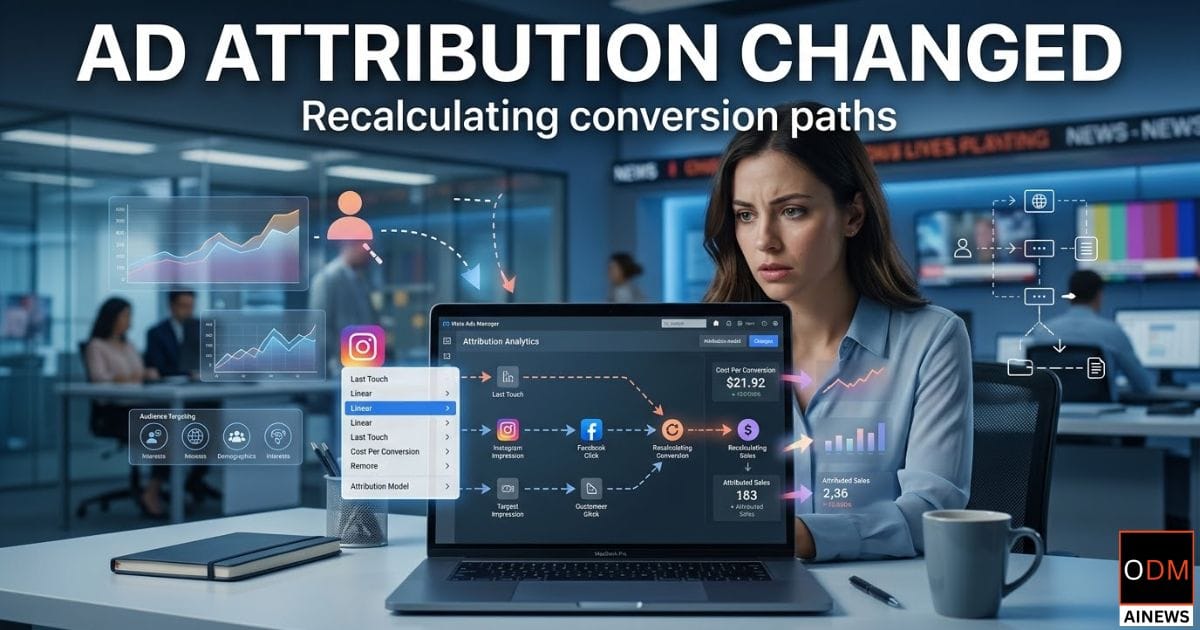
Your Meta Ads Manager conversion numbers are about to drop. Not because your campaigns are performing worse but because Meta changed what it’s counting. On March 3, 2026, Meta published a blog post titled “Simplifying Ad Measurement for a Social-First World” and announced the most significant restructuring of its conversion measurement framework since the iOS 14 privacy changes. The Meta ad attribution change 2026 click-through engage-through update is now rolling out across advertiser accounts globally, and if you haven’t adjusted your dashboards yet, you’re about to have a very uncomfortable client call.
The root cause was a problem that has irritated performance marketers for years: Meta’s Ads Manager and Google Analytics almost never agreed. Meta showed 300 conversions. GA4 showed 87. The discrepancy wasn’t a glitch it was structural, baked into how Meta defined a “click.” And for years, Meta left it that way.
What Changed in Meta’s Attribution Model
Three specific things changed, all announced simultaneously on March 3, 2026.
First, click-through attribution now counts only link clicks clicks that actually send a user to your website or landing page. Previously, Meta included every type of ad interaction in its click-through definition: likes, shares, saves, comments, profile views, and link clicks all qualified. A user who saved your ad and bought something three days later was counted as a click-through conversion. That is no longer the case.
Second, a new attribution category called engage-through attribution replaces what was previously called engaged-view attribution. All the non-link interactions likes, saves, shares, bookmarks, comments now sit in this new bucket. It applies across all ad formats, not just video. The conversion window for engage-through is one day.
Third, the video engaged-view threshold has been halved from 10 seconds to 5 seconds. For video ads under 5 seconds in length, the threshold becomes 97% of the total video duration. Meta’s rationale is data-driven: according to its own announcement, 46% of online purchase conversions with Reels now happen within the first two seconds of attention on video ads. The 10-second standard was calibrated for longer Facebook Feed videos. Reels audiences convert faster.
Click-Through Attribution: What It Means Now
Click-through attribution has a clean, simple definition under the new model: a user clicked a link in your ad that sent them to your destination URL, and then converted within the window you’ve set typically seven days.
Meta’s stated logic is that this mirrors how click-throughs work in search advertising, where the metric originated a user typed a query, clicked an ad, and either converted or didn’t. By aligning with that standard, Meta’s numbers should now sit much closer to what GA4 and third-party tools report.
The practical effect for advertisers: if your campaigns relied heavily on remarketing audiences people already familiar with your brand who might save an ad on Monday and buy on Thursday your click-through conversion count will fall. Those saves-followed-by-purchases used to count as click-through conversions. They don’t anymore.
Engage-Through Attribution: What It Captures
Engage-through is not a downgraded metric. It’s a different signal and understanding the distinction is where most advertisers will go wrong.
A purchase that followed a direct link click to your product page is a different signal than a purchase that happened within a day of someone saving your ad. The first reflects explicit purchase intent. The second reflects brand interest or awareness valuable, but not the same thing. Treating them as equivalent, which the old model quietly allowed, was the source of much of the inflated conversion reporting.
Engage-through carries a one-day window. That’s the critical constraint. Non-link interactions that previously led to a conversion on days two through seven under the old click-through window will no longer be attributed at all. Some conversions will genuinely disappear from your reports not because the sale didn’t happen, but because it now falls outside any attribution window.
Jon Loomer, a Meta advertising analyst who confirmed through his own account testing that Meta’s old click-through attribution included all click types, put the downstream impact plainly: “Most won’t notice it. You may be able to spot changes if you use the Compare Attribution Settings feature or Breakdown by Attribution to see how click-through and engage-through numbers evolve.” He noted that advertisers running heavy remarketing campaigns are the most likely to see a measurable shift.
How This Affects Your Campaign Performance Data
The numbers will change. Understanding which direction each metric moves is essential before you try to explain the shift to anyone.
Your engage-through conversions will increase or appear for the first time if you haven’t been tracking that attribution type. The combined total of click-through plus engage-through should be similar to your previous click-through total, though the exact split will depend on how much of your prior attribution was driven by social interactions versus link clicks.
The gap appears in the window mismatch. Under the old model, a seven-day click-through window captured conversions from likes and saves up to a week after the interaction. Engage-through only has a one-day window. Anything that happened in days two through seven from a non-link interaction is simply gone from your attribution. This is not a performance decline but it can look like one if you’re comparing new numbers to historical benchmarks without accounting for the reclassification.
There’s also a structural incentive worth naming. Engage-through is the model Meta’s algorithm prefers, because it feeds more conversion signals back into the ad delivery system. By migrating likes, saves, and shares out of click-through and into engage-through, Meta has created a situation where full conversion visibility now requires opting into the model Meta wants you on. That’s not cynicism it’s a reasonable observation about how platform incentives work.
Which Metrics Will Look Different in Ads Manager
Cost per result will likely increase for website conversion campaigns not because efficiency dropped, but because fewer actions now count as results under the click-through definition. If your campaign target was a CPA of ₹300, built on the old attribution, that benchmark will need to be recalibrated against the new definition before you can draw meaningful comparisons.
Meta also pointed to incrementality testing, including Conversion Lift experiments, as a preferred way to understand outcomes that would not have happened otherwise. This is the right framing. Attribution any attribution is an approximation. Lift testing gives you a more defensible measure of actual campaign impact.
Video ad performance metrics will also shift. Ads that previously needed 10 seconds of viewing to qualify for an engaged-view conversion now need only 5. This means video campaigns should see an increase in engage-through attributed conversions, particularly on Reels. If your video ad has its brand message and product shot in the first five seconds, you’re now in the attribution window. If your brand moment appears at second eight or later, it doesn’t count.
How to Adjust Your Reporting and Benchmarks
The first move is to stop comparing new numbers directly to historical data without a correction note. Document the date the change rolled out on your account check your Ads Manager for the notification and treat everything before and after as two different measurement periods.
Second, activate the Breakdown by Attribution feature in Ads Manager to see how conversions are now distributing across click-through, engage-through, and view-through categories. This breakdown was always available but rarely used. It’s now essential.
Third, recalculate your performance benchmarks CPA, ROAS, cost per lead using at least 30 days of post-rollout data before setting new targets. Any target set against the pre-March model is measuring a different thing.
Impact on ROAS Calculations for Indian Advertisers
Indian D2C brands and performance marketing teams should expect an initial dip in reported ROAS figures, particularly for campaigns that relied on Reels-driven engagement and remarketing. The dip is cosmetic the sales are still happening but it will require clear explanation to clients or internal stakeholders who track ROAS on a weekly dashboard.
The more substantive impact is on budget allocation decisions. If a campaign’s ROAS drops from 4.2x to 3.1x purely due to attribution reclassification, and budget gets cut in response, actual revenue will fall even though the underlying campaign performance hasn’t changed. That’s the real risk misreading a measurement change as a performance change and making a budget decision based on the misread.
For agencies managing multiple accounts, the priority right now is proactive client communication. Send a brief explainer before the numbers shift. The worst version of this conversation is a client calling you to ask why ROAS dropped 25% and your answer being “Meta changed the attribution model” reactive, confusing, and avoidable.
Meta is partnering with analytics providers like Northbeam and Triple Whale to incorporate both clicks and views into attribution models, aiming to give advertisers a more complete performance picture. Indian agencies already using those tools should check for updated integration documentation.
Step-by-Step: Update Your Ad Attribution Settings
Open Meta Ads Manager and navigate to the ad set level of any active website or in-store conversion campaign. Under the Attribution Setting section, you’ll see the current default: 7-day click-through, 1-day engage-through, 1-day view-through. This is the new default Meta is rolling out.
Review whether engage-through should remain on for your specific campaign objectives. For purchase campaigns, Jon Loomer recommends keeping the default 1-day engage-through on a social interaction before a purchase still reflects ad impact, even if the final conversion happened via another path. For lead generation campaigns, the logic is less clear. If someone didn’t click through to get your lead magnet, the ad’s contribution to that lead is genuinely debatable. Consider turning engage-through off for lead campaigns and measuring the effect.
For video campaigns, review where your brand message, product shot, or key call to action appears in your video’s timeline. If it sits after the five-second mark, consider editing the video to front-load the core message. Not for creative reasons for measurement reasons. Visibility inside the attribution window now depends on it.
Finally, if you use automated bid strategies target ROAS or cost-per-result check delivery after the rollout. If your targets were calibrated on old attribution numbers and conversion volume drops under the new model, the algorithm may struggle to find enough conversion signals to pace correctly. Loosen targets temporarily while the system recalibrates on 30 days of fresh data.
What This Means for You
The Meta ad attribution change 2026 click-through engage-through update does not change how your campaigns are billed or how ads are delivered. What it changes is the accuracy of what you’re measuring and that accuracy is, ultimately, what all campaign decisions are built on.
The brands and agencies that treat this as a data housekeeping exercise and move on without adjusting benchmarks, client communications, or bidding logic will spend the next quarter chasing problems that don’t exist. The ones that take two hours to recalibrate their dashboards now will have cleaner data, better decisions, and significantly fewer awkward reporting conversations. That is a straightforward trade.