
Meta’s AI Ad Push Is Already Bigger Than Most Advertisers Realise
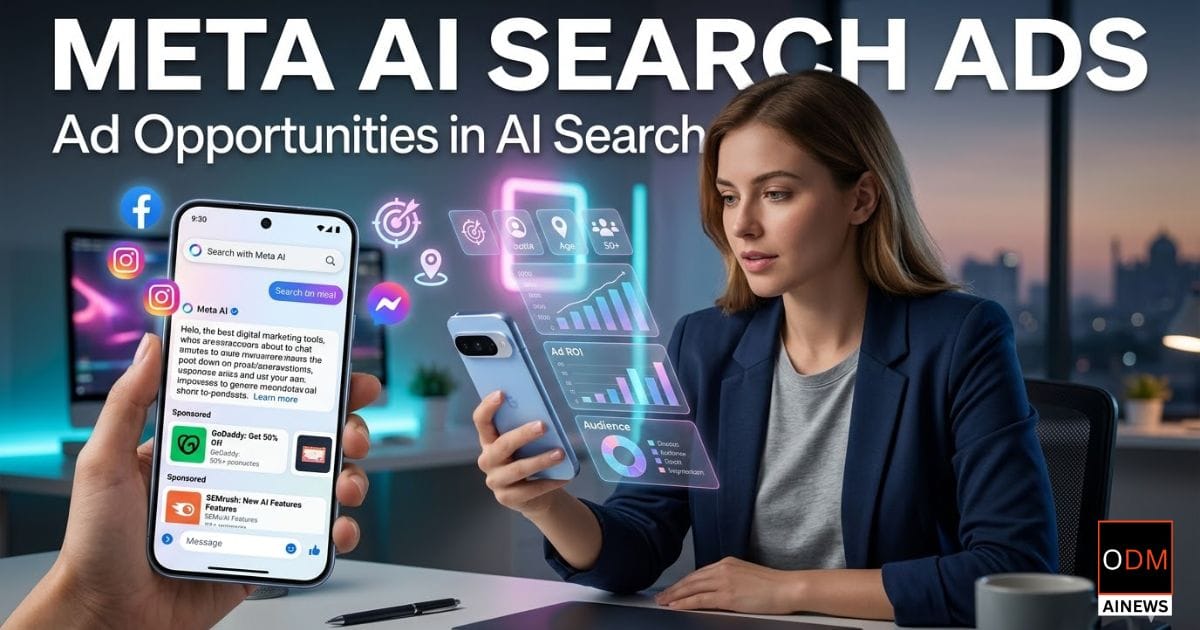
Meta’s advertising AI didn’t arrive quietly. Since December 2025, every conversation you’ve had with Meta AI across Facebook, Instagram, WhatsApp, and Messenger has been feeding the ad targeting system a change that affects over a billion monthly Meta AI users globally, with no opt-out available in most regions. That’s the foundation. What’s being built on top of it is even more significant. Meta AI search ads on Facebook and Instagram in 2026 represent the company’s most aggressive attempt yet to collapse the distance between a marketing budget and a live, optimised campaign.
Mark Zuckerberg described the vision plainly: “You tell us what your objective is, you connect to your bank account, you don’t need any creative, you don’t need any targeting demographic.” That quote, from mid-2025, now reads less like ambition and more like a product roadmap hitting its deadlines.
How Meta AI Search Ads Work
The system Meta is building and in parts has already deployed works in stages. At its most basic level, an advertiser provides a product image, a URL, and a budget. Meta’s AI then generates the creative: images, video variations, ad copy, and format selection across placements. It also decides who sees the ad, when, and on which surface Facebook Feed, Instagram Reels, Stories, or Messenger.
What makes this different from previous automation tools is the data layer underneath. Starting December 2025, Meta began using conversations users have with Meta AI to personalise ads across its apps. So the AI isn’t just optimising against click history or page likes. It’s working with intent signals from real conversations someone asking Meta AI about home renovation is now a potential target for hardware brands, even before they’ve searched for anything publicly.
Meta also adopted a new sequence-learning architecture a system designed to understand information that comes in a specific order, like words in a sentence or steps in a process allowing it to use longer user behaviour sequences and incorporate additional organic engagement data. That drove a 3.5% lift in ad clicks on Facebook and over 1% gains in Instagram conversions in Q4 2025. Small numbers, large revenue base. The maths matters.
How This Differs from Existing Facebook and Instagram Ads
The difference is structural, not just incremental. Traditional Meta ads required advertisers to define audiences, write copy, design creatives, set placements, and manage budgets manually or use third-party tools to do so. Advantage+, Meta’s earlier automation suite, automated parts of that process: testing creative variations, expanding audiences, adjusting bids. It was assistance, not autonomy.
What Meta is building now goes further it aims to automate the creative process entirely, tailoring content to user-specific factors like geolocation. The intent is to remove human input from execution altogether. You set the goal. The machine runs the campaign.
Meta’s Andromeda system a next-generation AI ranking and delivery engine processes massive volumes of data in real time to decide which ad should be shown to which person, at which moment, relying less on advertiser-defined inputs and more on who is most likely to act right now. For advertisers used to controlling placement and audience, that’s a fundamental shift in what the job actually involves.
Targeting Capabilities of AI Search Ads
The targeting layer is where the commercial stakes are highest and where privacy questions are loudest.
Beyond AI conversation data, Meta’s systems now work with what it calls implied intent: behavioural signals drawn from what users watch, pause on, and engage with organically. Meta’s feed and video ranking improvements in Q4 2025 delivered a 7% lift in views of organic posts, with video time spent growing double-digits year-over-year in the US. That engagement data flows directly into ad targeting models.
For advertisers in India, there’s a specific development worth noting. Meta now enables advertisers in India to target users by income brackets a major step forward in precision marketing. Combined with AI-driven creative personalisation, this means Indian brands can now reach specific economic segments with content adapted in real time, not just translated or resized.
The counterpoint is legitimate: there’s no way to identify users reached through AI conversation data in Meta Ads Manager the conversation data gets incorporated into Meta’s overall algorithm but isn’t broken out separately. You can infer impact from performance shifts. You can’t audit the attribution directly. That opacity is a genuine limitation for advertisers who need to explain ROI at a granular level.
Which Advertisers Are in Early Testing
Meta introduced 11 new AI advertising tools at Cannes Lions 2025 and confirmed a $14–15 billion investment in Scale AI, acquiring a 49% stake to boost its global AI infrastructure. The early testing cohort has been weighted toward large-scale advertisers brands with sufficient historical data to train the AI systems effectively.
Meta began testing a Meta AI business assistant with advertisers in Q4 2025 to help with optimisation and account support, with plans to expand it so more businesses can chat with an assistant that remembers their goals and offers personalised performance recommendations.
Small and mid-sized businesses are the stated next priority. The initiative is expected to especially benefit small and medium-sized businesses, which form the bulk of Meta’s advertisers and often lack the resources for full-scale ad production. Whether the AI’s output quality holds up for brands without years of first-party data remains an open question.
Expected Pricing and Campaign Structure
Meta hasn’t published a formal pricing structure for fully automated AI ad campaigns, and that’s deliberate. The model appears to be budget-input driven: you set a total spend figure, and the AI allocates across placements, formats, and audience segments dynamically.
Meta now encourages Consolidation Campaigns where all audiences and creatives live inside a single smart campaign with Meta’s AI deciding which ad to show to which person. The practical effect is that CPMs become harder to predict in advance, because placement and audience selection happen at runtime. What you get instead is a cost-per-result figure that Meta’s system optimises toward. For advertisers used to granular budget control, this is uncomfortable. For those who’ve struggled to manage complex campaign structures, it’s a relief.
Rahul Panchal, a performance marketing specialist working with D2C brands in Mumbai, noted in a February 2026 post that consolidation campaigns have reduced his clients’ cost-per-acquisition by 20–30% in categories with rich creative libraries but produced inconsistent results for brands with fewer than five active creatives. The AI needs volume to learn from.
How to Prepare Your Brand for Meta AI Search Ads
Start with your creative assets. The AI generates variations, but it generates them from what you give it. The updated Advantage+ ad suite now includes automated brand consistency features including logos, fonts, and colours and a new image-to-video tool that allows advertisers to turn up to 20 product photos into multi-scene video ads. If your brand has inconsistent visual identity or a shallow asset library, the AI will produce inconsistent output. Fix the inputs before the automation arrives.
Second, audit your first-party data. The brands that will get the most from Meta’s AI systems are the ones whose customer data purchase history, email lists, CRM segments is clean, current, and connected to Meta via the Conversions API. That data trains the AI on what your actual customer looks like, rather than having it guess from general platform behaviour.
Third, stop treating creative as a one-time task. Brands that test multiple creatives formats, messages, angles give Andromeda more data to learn from, and the system rewards them with better delivery. In 2026, creative isn’t a campaign asset. It’s a training signal.
Impact on Existing Meta Advertising Strategies
The honest answer is that manual audience targeting is becoming obsolete on Meta not as a policy, but as a performance matter. Advertisers who restrict placements, hand-pick interest segments, or build rigid funnel structures are fighting a system that’s optimised to ignore those constraints.
Restricting ads to specific placements like “Instagram Reels only” or “Facebook Feed only” is an outdated tactic that limits the algorithm’s efficiency, because Meta automatically adjusts sizing and placement when creatives are uploaded using flexible setups.
What doesn’t change: brand strategy, creative direction, and the ability to judge whether an AI-generated output actually represents your brand accurately. Poorly executed AI ads, creative fatigue, or a flood of low-quality campaigns could diminish user experience or backfire on brand trust. The machines don’t know when they’ve got your brand wrong. You do.
Timeline When Indian Advertisers Can Access This
The full end-to-end AI ad creation suite image in, campaign out is targeted for rollout by the end of 2026. Meta CEO Mark Zuckerberg described the goal as: “You tell us what your objective is, you connect to your bank account, you don’t need any creative, you don’t need any targeting demographic.” Several components of this system are already live: AI-generated creative variations, Advantage+ campaign consolidation, and AI conversation-based targeting.
For Indian advertisers, access to full automation tools typically follows the US rollout by two to four quarters, depending on regulatory environment and local infrastructure. Given that Meta is expanding advertiser verification to ensure verified advertisers drive 90% of ad revenue by end of 2026, up from 70% today, Indian brands that complete verification now will be better positioned for early access when the tools extend to this market.
The income-bracket targeting feature is already live in India. AI-generated creative tools via Advantage+ are partially available. Full campaign automation the Zuckerberg vision is likely to reach Indian advertisers in phased access starting Q3 or Q4 2026.
What This Means for You
Meta AI search ads on Facebook and Instagram in 2026 are not a future scenario. They’re an active rollout, and the brands arriving late will pay for that delay in higher costs and lower placement priority while competitors’ AI systems accumulate the learning advantage.
The strategic question isn’t whether to adopt these tools. It’s whether your brand is ready for a system that replaces creative and targeting decisions with machine judgment. That requires strong brand identity, clean data, and enough creative volume to give the AI something to work with. Get those fundamentals right, and Meta’s automation becomes an accelerant. Ignore them, and the AI will produce generic, off-brand campaigns at whatever speed you’ve funded.