
The Customer Just Left the Building
Around 2% of all ChatGPT queries are shopping-related things like “recommend a laptop under $1,000” and “how much are running shoes.” That comes to roughly 50 million shopping queries daily. That number, from OpenAI’s own economic research team, is where the AI purchasing agents marketing impact 2026 story actually starts not with a prediction, but with a volume of intent-driven behaviour already happening at scale, mostly invisible to the brands being evaluated inside those conversations.
The race to own that channel is fully underway. Amazon expanded its Rufus shopping assistant with an automatic-buying feature. OpenAI embedded checkout directly into ChatGPT. Perplexity rolled out an AI-powered browser. Google announced its Universal Commerce Protocol at the National Retail Federation conference in January 2026 with Walmart, Target, and Shopify among the first partners. The infrastructure for AI agents to buy things on behalf of humans is no longer theoretical. It is live, partially, and expanding.
What AI Purchasing Agents Actually Are
The definition matters because it’s being stretched in every direction right now. An AI purchasing agent is not a chatbot that recommends products. It’s a goal-directed system that can plan a sequence of actions, query APIs, evaluate product data against user-defined criteria, and execute a transaction all without the user navigating a single product page.
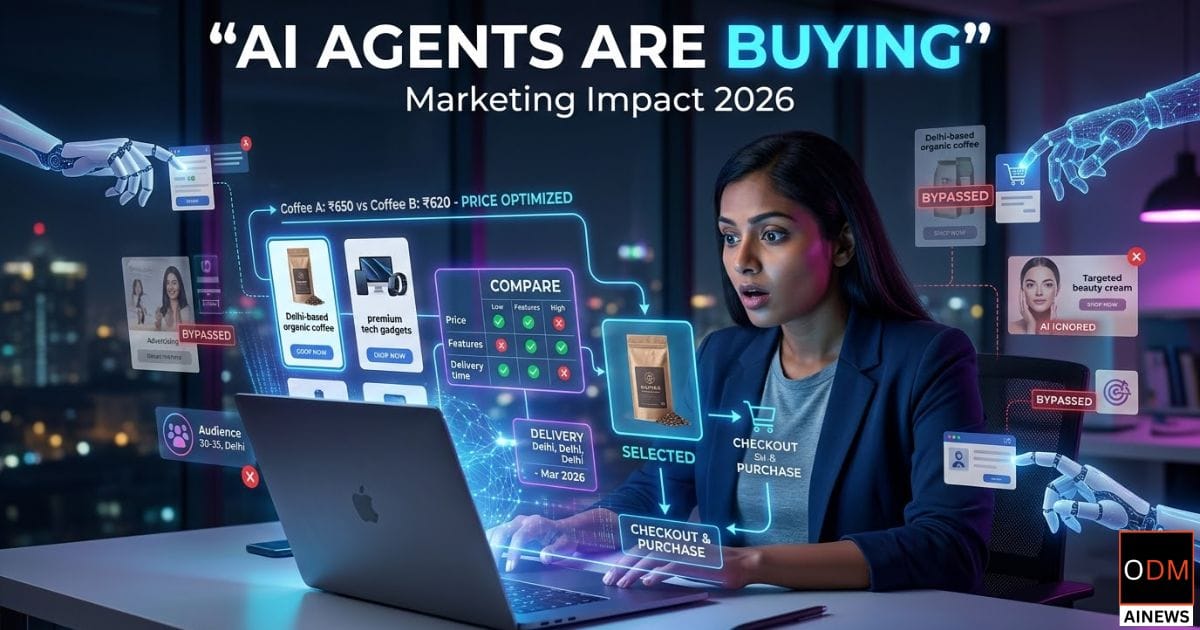
In systems such as ChatGPT and Gemini, a user prompt is parsed into structured intent. The agent then constructs a structured query instead of interpreting web page layouts or visuals. A user types “Find me running shoes under ₹8,000, size 9, with good cushioning and next-day delivery” and the agent extracts those constraints as machine-readable parameters, queries product feeds that support structured data, ranks results against the criteria, and either surfaces a shortlist or completes the checkout directly. The user never visits a product page. They may never visit your website at all.
Orders, payments, and fulfilment are handled by the merchant using their existing systems. ChatGPT simply acts as the user’s AI agent securely passing information between user and merchant, just like a digital personal shopper would. The merchant remains in control of the customer relationship. But the discovery and decision happened somewhere else entirely.
How AI Agents Make Buying Decisions
The criteria an AI agent applies when ranking products are not the same criteria a human shopper uses when browsing. Humans respond to product photography, brand storytelling, social proof displayed on product pages, and the general feel of a well-designed storefront. AI agents respond to structured data: price, availability, specifications, shipping speed, return policy terms, and review aggregates all extracted programmatically from product feeds and schema markup.
Customers who use Amazon’s Rufus during their shopping journey are 60% more likely to convert. That lift comes from the agent’s ability to match stated user intent against specific product attributes accurately. The implication for brands is uncomfortable: a product with excellent positioning, beautiful photography, and a compelling brand story can lose to a competitor with superior structured data, because the agent never sees the story it only reads the schema.
Scot Wingo, founder of ReFiBuy, a company that helps brands and retailers optimise for agentic AI, said: “GenAI knows far more about the shopper than Google ever did; the job now is to expand and contextualise the product catalog so the engine can map that shopper context to the right SKU.” That is the clearest practical summary of what brands actually need to do.
Which Industries Are First Affected
Travel moved first. The sweet spot for AI agents is complex, multi-step goals travel planning, home office upgrades, or bundled purchases where a conversational agent outperforms search. A user asking an AI to plan a four-day trip to Coorg within a ₹40,000 budget, including flights and accommodation, is a task that search handles poorly and an AI agent handles well. The agent queries flight APIs, hotel availability, package pricing, and user preferences simultaneously, then presents a shortlist. Several OTAs have already integrated ACP and UCP to ensure their inventory surfaces in these agent-driven results.
E-commerce is the largest near-term battleground. Shoppers quickly found out that they could rely on ChatGPT and similar platforms for product discovery, feature comparison, and price optimisation and the commerce platforms accelerated to meet that behaviour. SaaS procurement is the B2B equivalent: Gartner forecasts that by 2028, 90% of B2B buying will be AI agent intermediated, pushing over $15 trillion of B2B spend through AI agent exchanges. Procurement cycles that currently take weeks are projected to compress to hours, with agents evaluating performance metrics, risk factors, and contract terms autonomously.
How Brand Visibility Changes When AI Buys for Humans
This is the question most marketers haven’t fully reckoned with yet. When a human browses your product page, your entire brand infrastructure copywriting, imagery, UX, trust signals, reviews displayed on-page influences the decision. Agentic AI removes the session layer. Backend systems, not homepage design, now determine visibility in the digital ecosystem.
Your SEO ranking, your retargeting pixel, your hero banner, your testimonial section: none of these are seen by an AI purchasing agent. What the agent sees is your product feed’s structured data, your schema markup, your API’s response time, and your fulfilment capabilities. A brand with strong storytelling and weak product data will be invisible. A brand with mediocre storytelling and perfectly structured product data will be recommended.
Emily Weiss, Senior Principal Researcher at Gartner, said: “This marks the end of channel-based marketing as we know it. Marketers must prepare by putting strong data governance in place, tracking customer journey changes weekly, and integrating agentic systems into martech stacks to enable secure, ethical personalisation at scale.” That is not hyperbole. It is a technical description of what the transition requires.
New Marketing Strategies for the AI Buyer Journey
The emerging discipline is Answer Engine Optimisation AEO applied specifically to commerce. GenAI platforms are evolving into full commerce channels, prompting brands to optimise for machine-readable product data and for AEO. Where SEO optimised for human search behaviour, AEO optimises for the criteria AI agents apply when evaluating products programmatically.
Three shifts define the new strategy. First, brand marketing must move upstream into the data sources AI agents trust. Review aggregators, independent product databases, and structured Q&A sources that AI models are trained on need to carry your brand’s accurate, favourable data. Second, conversion optimisation now targets the agent, not the consumer. If your product feed doesn’t expose return policy terms, sustainability certifications, or exact specification data in machine-readable format, those attributes don’t exist in the agent’s evaluation. Third, loyalty and post-purchase experience remain firmly human and that is where the brand relationship now has to be built, because the pre-purchase journey belongs increasingly to the agent.
How to Make Your Brand AI-Agent-Friendly
To make your product catalogue legible to AI assistants and shopping agents, use structured data markup JSON-LD with Schema.org to ensure that price, availability, shipping, and product attributes are explicitly machine-readable. Combine this with an API that supports natural language queries and consider adopting the Model Context Protocol, an open-source standard for AI-to-data connectivity.
For Shopify merchants, the path is relatively direct: Shopify’s Universal Commerce Protocol provides the infrastructure that lets AI agents discover your products and complete transactions within AI conversations on platforms such as ChatGPT, Google AI Mode, Gemini, and Microsoft Copilot. For brands on other platforms, the technical requirement is the same structured product feeds, ACP or UCP integration, and an API layer that agents can query without navigating your frontend.
One important counterpoint, worth stating clearly. Just 23% of Gen X US online adults have used ChatGPT in the past month to search for products, per Forrester’s December 2025 Consumer Pulse Survey. Adoption climbs for Millennials (32%) and Gen Zers (35%). This is not mass consumer behaviour yet. The infrastructure is racing ahead of adoption. OpenAI itself pulled back its ChatGPT Instant Checkout feature in early March 2026, with Forrester noting the market is still in an experimental phase. Brands should prepare seriously without treating the transition as already complete.
India E-Commerce How Big Is This Threat?
India’s e-commerce market is projected to reach $147 billion by 2027. The country has the second-largest internet user base in the world and one of the fastest-growing Gemini adoption rates Gemini leads India’s AI chatbot market with 52% of AI chatbot downloads. Those two facts together mean Indian consumers are already using AI tools with the highest rates of Google integration, on a commerce market that is still structurally fragmented across Flipkart, Amazon India, Meesho, JioMart, and direct-to-consumer brands.
That fragmentation is both a risk and an opening. Brands with strong first-party product data, structured feeds, and ACP-compatible checkout will surface in AI agent recommendations on a market where competitors may not have made those investments yet. The brands that will be hurt are those relying entirely on human-browsed marketplaces, discoverability through social ads, and branded landing pages all surfaces that AI purchasing agents bypass entirely.
The categories with highest immediate exposure in India are consumer electronics, fashion, travel booking, and FMCG subscription purchases. These are the categories where AI agents already handle complex, multi-attribute decisions well and where Indian consumers have the highest digital transaction frequency.
Preparing Your Brand for the AI Agent Economy
By 2027, 35% of countries will be locked into region-specific AI platforms using proprietary contextual data. For Indian brands, that means the agent ecosystem is not one platform it’s Gemini, ChatGPT, and eventually local or regional AI tools with different data requirements. Building for one protocol isn’t enough. The practical answer is building to standards that multiple protocols can consume: Schema.org product markup, clean and complete product feeds, open APIs, and review presence on aggregator platforms that AI models use as training data.
By the end of 2026, 25% of enterprise software purchases will involve some form of AI agent mediation, according to Gartner. For B2B brands in India SaaS, professional services, hardware, logistics that means procurement decision-makers are already beginning to delegate initial vendor evaluation to AI tools. Your brand’s presence in AI-accessible data sources, your structured case studies, and your API-ready pricing documentation are the new sales collateral.
The timeline here is not years away. The infrastructure is live. The adoption curve is climbing. And the brands that treat product data quality as a marketing priority rather than a back-office operational task will have a structural advantage that compounds as agent adoption grows.
What This Means for You
The AI purchasing agents marketing impact 2026 is not a single event. It’s a shift in where purchase decisions get made from a consumer’s deliberate, brand-influenced browsing session to an AI agent’s structured, criteria-driven API query. The transition is uneven, adoption is still early in consumer markets, and the infrastructure is maturing in real time. But the direction is confirmed by everyone from Gartner to OpenAI to Google to McKinsey.
The practical response is not to rebuild your marketing around a future that isn’t quite here yet. It’s to ensure that your product data is ready for agents when they arrive in force because the brands that scramble to fix their schema markup and product feeds after agent-driven commerce goes mainstream will be fixing it while competitors are already being recommended. That window is open now. It won’t stay open indefinitely.