The Funnel Didn’t Bend It Broke
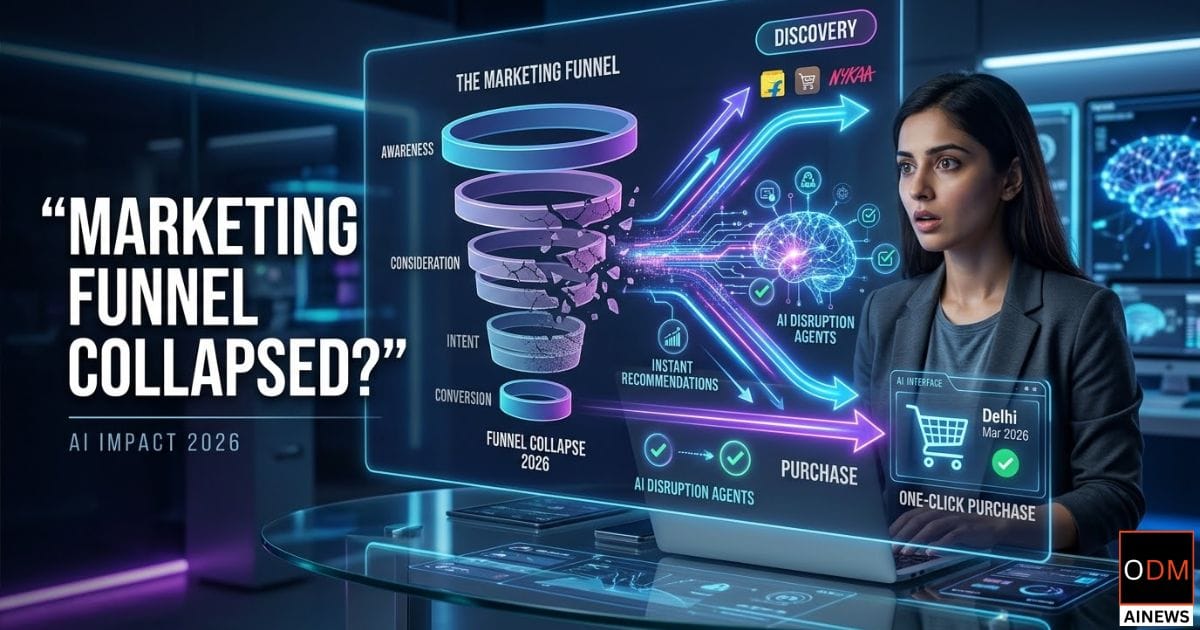
Thirty-three percent of US adults now discover brands through personal AI agents. Forty-seven percent already use AI tools to research purchases. When AI collapsed marketing funnel 2026 becomes the defining phrase in strategy documents across the world’s largest marketing organisations, it’s worth pausing on what “collapsed” actually means because it’s not metaphor. Discovery, evaluation, and purchase are compressing into a single AI-mediated moment, and the four-stage funnel that structured marketing budgets, team roles, and measurement frameworks for thirty years is not adapting to that. It’s being bypassed entirely.
The BCG and Moloco AI Disruption Index based on a global survey of 283 senior marketing leaders across 15 verticals and five regions, reinforced by performance data from over 3,000 mobile apps representing more than 200 billion downloads is the most rigorous dataset yet on what that bypass looks like in practice. The numbers aren’t projections. They’re current behaviour.
How AI Changed the Buyer Journey
The traditional funnel assumed that a consumer moved through distinct stages awareness, consideration, intent, purchase each of which took time and could be influenced by targeted content or ads at the right moment. AI has collapsed that assumption by compressing what was once a multi-stage journey into a single conversational flow.
A user who asks an AI agent to recommend running shoes under ₹8,000 with good arch support and same-day delivery does not browse awareness content, click a retargeted ad, land on a product page, and then decide. The entire journey from stated need to ranked shortlist to transaction happens inside one interaction. The brand’s homepage, its hero banner, its consideration-stage blog content: none of it is in the room.
Paul D’Arcy, CMO of Moloco, put the scale of that shift plainly at CES 2026: when a Google AI Overview appears, 80% of the time there is no click. “That’s a rate of behavioural change that really is unprecedented.” Organic CTR is down 65% when AI overviews appear. Paid CTR has fallen 68%. The funnel isn’t leaking. The top of it is no longer generating sessions.
The Data What the Evidence Actually Shows
The Moloco-BCG report found one consistent pattern across all 15 verticals studied: strong, direct customer relationships dramatically reduce AI disruption risk. Brands with high mobile app engagement, habitual usage patterns, and access to first-party data are far less dependent on the disrupted channels search, programmatic web advertising, affiliate traffic that the collapsed funnel is hitting hardest.
Funnel’s 2026 research adds a parallel finding: 80% of marketers feel pressure to adopt AI, but only 6% have fully embedded it into their workflows. Meanwhile, 72% of in-house marketers and 55% of agency marketers struggle to turn data into actionable insight. The result is what the research describes as a “B– performance cycle” teams analysing reports on what happened rather than understanding why, or what to do next.
The counterpoint worth stating: the BCG data is US-centric, and consumer behaviour in AI-assisted discovery varies significantly by market, age cohort, and category. Auto marketplace CMOs in the report themselves cautioned that AI guidance can help, but doesn’t replace visual browsing and listing comparison. The collapse is not uniform across all categories and all markets. It is, however, directional and the direction is consistent.
What the New Marketing Journey Looks Like
The replacement for the funnel isn’t a new funnel. It’s a different model entirely. The Moloco-BCG report describes it as a “trust web” a network of direct, high-frequency brand interactions that don’t depend on being discovered through intermediary channels.
Inspiration, search, and decision-making are no longer separate steps. A consumer might ask an AI what laptop suits a content creator with a ₹70,000 budget, receive a ranked shortlist with reasons, and place an order inside the same session. The brand that wins that transaction was visible in the AI’s answer, not in the consumer’s browsing session. What builds visibility in an AI answer is different from what builds visibility on a search results page: it’s entity authority, structured product data, verified review aggregates, and the brand’s presence in the data sources the AI model was trained on and continues to query.
How Top CMOs Are Restructuring Their Strategy
The Moloco-BCG report identifies three strategic priorities that forward-looking CMOs are already acting on. The first is investing in owned digital experiences particularly mobile apps which allow brands to control discovery, personalisation, and conversion without depending on third-party discovery channels. Fintech platforms cited in the report show 71% retention and 81% app-based engagement, and their AI disruption risk is rated as “Secured” precisely because they don’t depend on search to get found.
The second priority is owning and activating first-party customer data, building data capture into the full journey rather than only at checkout. The third is restructuring marketing workflows to separate strategic work where humans are irreplaceable from operational output, where AI can produce at scale.
Empathy Lab’s February 2026 “Growth Operating System” report makes the same structural argument differently: CMOs face a binary choice between automating tasks and orchestrating outcomes. Orchestration means connecting creativity, media, pricing, product, data, and governance into one system. Automation without that orchestration produces efficient output that is disconnected from enterprise growth. That distinction is where the restructuring actually sits.
Content Strategy for the Collapsed Funnel
The traditional content calendar organised itself around funnel stages awareness blogs, consideration guides, decision-stage case studies. That structure assumed sequential movement through the funnel. It no longer maps to how buyers actually move.
The replacement framework is topical authority combined with answer-engine readiness. Rather than targeting individual funnel stages, brands need to own the full topic cluster every question a buyer might ask at any stage of their decision and structure that content so AI systems can extract accurate, direct answers from it quickly. Linda Orr, fractional CMO and marketing data analyst with 25 years of experience, describes the new job plainly: “Discovery is shifting. More people are getting answers from AI-driven interfaces and summary experiences that changes the job from ‘rank a page’ to ‘become the trusted source an answer engine wants to reference.'”
Thirty percent of consumers are already comfortable letting AI make purchases on their behalf. For those buyers, no amount of consideration-stage content matters if the brand isn’t visible in the AI’s decision framework. Content strategy has to reach the agent, not just the human.
Budget Reallocation Where CMOs Are Shifting Spend
Paid search is becoming an amplifier, not a foundation. The brands managing this transition well are treating paid as a tool for capturing intent that already exists, not for building it from scratch. The structural investment is moving toward compounding channels content authority, email, community, owned app experiences, PR and earned media where the value of the asset accumulates over time rather than resetting to zero when the budget stops.
Forrester’s 2025 research found that 72% of CMOs say their credibility with finance depends on demonstrating direct revenue impact. In 2026, that pressure has accelerated the shift from activity metrics to outcome metrics. Customer lifetime value is replacing cost per acquisition as the primary efficiency metric not because CAC doesn’t matter, but because rising acquisition costs in disrupted channels make retention economics more important than they’ve been in a decade.
Gartner projects that by 2027, 80% of enterprise marketers will use generative AI daily. The CMOs building toward that future are setting governance frameworks now defining where AI should handle production tasks and where human oversight is non-negotiable rather than adopting tools reactively and managing the brand integrity fallout later.
India Is the Funnel Collapsing Here Too?
The BCG-Moloco dataset is global but weighted toward US and European consumer behaviour. The structural dynamics are real in India, but the timeline and category distribution differ.
India’s digital advertising market reached ₹49,000 crore in FY2025 and is growing at 25–30% CAGR. Gemini leads India’s AI chatbot market with 52% of downloads. The consumers most exposed to AI-collapsed discovery in India are urban, Millennial and Gen Z, category-engaged fashion, consumer electronics, travel, and fintech. These are the buyers already using AI tools to research purchases, and the brands that show up in AI-mediated discovery in those categories are gaining an advantage that is difficult to close later.
The counterpoint for India is meaningful. A significant share of the Indian consumer base still discovers products through WhatsApp, regional social platforms, and physical retail channels that AI-assisted discovery has not disrupted at the same rate as formal search. The funnel collapse is not uniform across India’s diverse market. It is, however, most advanced in the categories with the highest digital transaction frequency which are also the categories with the fastest-growing market value.
New KPIs for 2026
The metrics that defined success in a funnel-structured marketing environment impressions, CTR, sessions, MQLs are increasingly measuring outputs that don’t correspond to revenue. The new KPIs being adopted by marketing teams adjusting to collapsed-funnel dynamics are: AI citation rate (how frequently the brand appears as a cited source in AI-generated answers for relevant queries); share of direct-to-app acquisition versus search-dependent acquisition; customer lifetime value by acquisition channel; and first-party data coverage as a percentage of the total customer base.
Supermetrics’ 2026 Marketing Data Report, based on 435 professionals surveyed from October to December 2025, found that 40% of marketers struggle to prove ROI across channels and only 33% can activate their data effectively. Those two gaps measurement and activation are where the new KPI frameworks will either succeed or produce the same B– performance cycle that better data promised to fix.
The underlying point, which Andrea Linehan, CMO of Supermetrics, states directly: “Data is evidence, not truth. Metrics are signals, not decisions.” In a collapsed-funnel environment, the skill is interpreting what the signals mean not collecting more of them.
What This Means for You
The AI collapsed marketing funnel 2026 is not a disruption to prepare for in future planning cycles. The BCG, Moloco, Forrester, Funnel, and Empathy Lab data all confirm it is happening in current behaviour, in current campaigns, in current attribution reports that CMOs are already struggling to explain.
The brands navigating this well share three characteristics: they have strong direct relationships with customers that don’t depend on intermediary discovery channels; they have first-party data infrastructure that gives AI systems an accurate picture of who their customers are; and they have restructured their content and measurement frameworks around answer-engine visibility rather than keyword rankings. None of those are fast fixes. All of them are available to start now.