
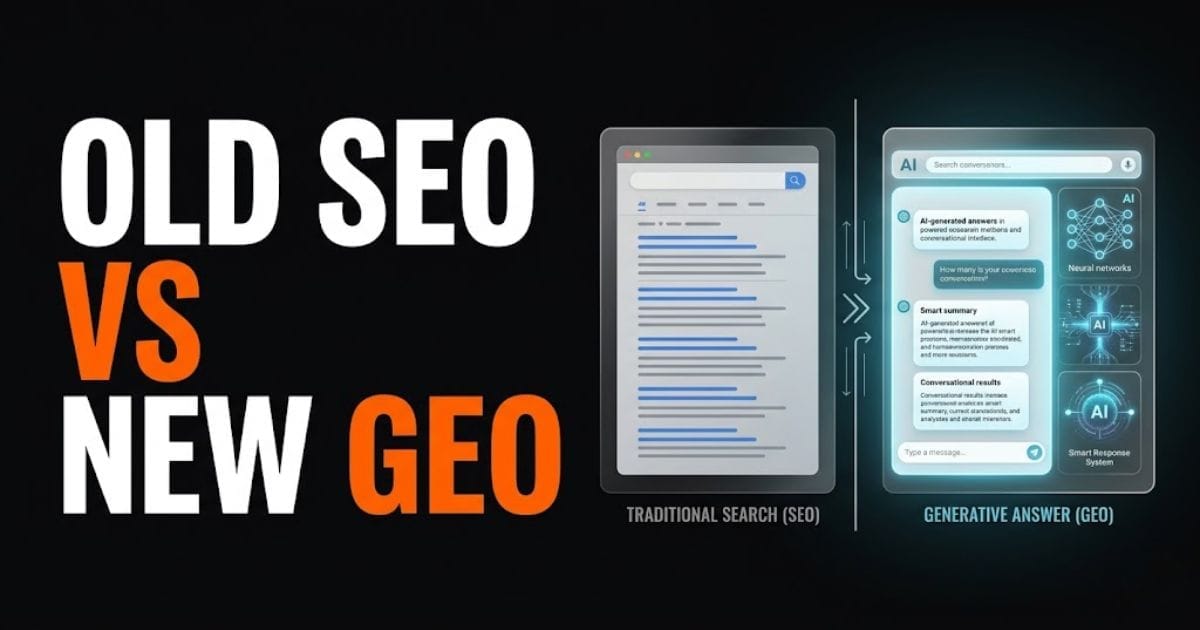
The New Reality of Digital Search
If you still think ranking first on Google is the only goal, you’re missing half the picture. The rise of AI search means understanding GEO vs SEO: Key Differences Every Marketer Must Know is no longer optional for your brand. Traditional search methods are facing their biggest challenge in decades.
You need to recognize that search behavior has changed. Users are moving away from clicking links and toward receiving instant answers. It is time to update your strategy before you lose your audience.
How SEO Targets the Traditional Algorithm
Search Engine Optimization (SEO) still focuses on ranking high in traditional search engine results pages. You optimize for keywords, backlinks, and page speed to satisfy search engine algorithms. It remains a reliable method for driving organic traffic directly to your website.
The goal of SEO is the click. You want users to land on your page and stay there. This requires technical precision and content that matches specific search intent. Keep your focus on the user experience to maintain these rankings.
Core Pillars of Traditional SEO
- High-quality keyword research and strategic placement.
- A healthy profile of authoritative backlinks.
- Fast loading times and mobile-first site architecture.
The Rise of Generative Engine Optimization
Generative Engine Optimization (GEO) is a newer discipline. It focuses on how Large Language Models (LLMs) like ChatGPT or Google Gemini perceive and summarize your content. The goal here isn’t just a blue link, but being the primary cited source in an AI-generated answer.
You must realize that GEO is not just a temporary trend. It is how a massive segment of your customers is now finding information. If an AI model can’t parse your data, your brand effectively doesn’t exist in conversational search.
GEO vs SEO: Key Differences Every Marketer Must Know
The most significant difference between these two strategies lies in how information is delivered. SEO wants the user to visit your site, while GEO wants the engine to trust your data enough to repeat it. This changes how you and your team should approach content creation.
In the world of GEO vs SEO: Key Differences Every Marketer Must Know, factual accuracy is your greatest asset. If an AI cannot verify your claims through other sources, it will likely ignore you entirely. Trust is the new currency for generative search results.
Integrating AI Tools for Digital Marketers
To stay ahead of the curve, you should integrate specific AI tools for digital marketers into your daily workflow. These tools help you analyze how generative engines interpret your brand’s core message. They allow you to find gaps where your competitors might be getting more citations.
Do not wait until your organic traffic drops to start experimenting. Use these tools now to see what the bots see. It is the best way to future-proof your digital presence.
Tactics for Winning in a GEO-First World
If you want to succeed with GEO vs SEO: Key Differences Every Marketer Must Know, you need to prioritize citations. AI engines love sources they can verify and point to. When your data is cited by other reputable sites, your brand’s GEO visibility naturally increases.
Essential GEO Strategies for Your Team
- Produce direct, factual answers to common industry questions.
- Use clear schema markup to help AI understand your data.
- Build authority by getting quotes from recognized human experts.
Think about your content as a contribution to a global knowledge base. Your brand needs to be the expert in the room for the AI to recommend you.
Measuring Success in the AI Era
In traditional SEO, you likely look at click-through rates and bounce rates. However, when examining GEO vs SEO: Key Differences Every Marketer Must Know, you must look at brand mentions and source citations within AI summaries. These metrics tell you if the AI considers you a leader.
Your reporting needs to evolve alongside technology. Make sure your team tracks how often you appear in generative snapshots. It is a different way of measuring reach, but it is just as vital.
Why You Must Master Both Frameworks
You cannot simply abandon SEO in favor of GEO. They are two sides of the same coin and work together to build your digital footprint. Good SEO provides the technical foundation, while GEO ensures you stay visible as search technology advances.
Balancing these two approaches is the new standard for modern marketing teams. You need to be visible both in the list of links and in the AI’s answer. It is a dual-track strategy for a dual-track world.
The Future of Digital Visibility
Mastering GEO vs SEO: Key Differences Every Marketer Must Know gives you a massive competitive edge. Many of your competitors are still ignoring the influence of generative search. If you act now, you can claim these AI citations before the market becomes saturated.
We are seeing a permanent change in how people interact with the internet. Most searchers now want the shortest path to a reliable answer. You must be that answer.
Final Thoughts on GEO vs SEO: Key Differences Every Marketer Must Know
The landscape is shifting, but the core objective remains the same: reaching your audience wherever they are. Whether they use a traditional search bar or a conversational AI, your content must be findable and clear. Use AI tools for digital marketers to keep your strategy sharp and your brand relevant.