The Channel Is Open With an Asterisk the Size of a Billboard
On February 9, 2026, OpenAI began running ads inside ChatGPT for US users on the Free and Go tiers. Six days later, Perplexity confirmed it had abandoned advertising entirely. Three days after that, Anthropic ran a Super Bowl commercial that, to many viewers, appeared to mock the idea of chatbots serving ads. In the same week. Advertising inside AI tools 2026 arrived not with unified industry momentum but with a platform-level identity crisis playing out in public and that tension is exactly the right context for deciding how much attention and budget to give it.
The infrastructure is real. ChatGPT’s 800 million weekly active users represent a scale no advertiser can dismiss. The intent signals inside AI conversations are more specific than anything search or social has historically provided. But the channel is nascent, access is restricted, measurement is opaque, and at least two major platforms have concluded that ads damage the core product. The honest assessment is: real opportunity, genuinely uncertain timeline, not for most Indian marketers in 2026.
Current State Who Has Launched What
ChatGPT is live with ads but closed to most advertisers. The February 9 launch was a beta restricted to a small group. As of mid-March 2026, there is no public ad platform, no formal buying process, and no confirmed timeline for broader access. OpenAI told one agency that reached out there is “no wait list.” The $200,000 minimum commitment confirmed to Adweek is the floor for entering the beta not the expected ongoing spend. That price point eliminates the vast majority of global advertisers from consideration right now.
Google runs ads within AI Overviews in Search and inside AI Mode, its conversational search experience. This is the most accessible AI advertising channel currently available, because it operates through existing Google Ads infrastructure. Advertisers using AI Max for Search campaigns report 14% more conversions at similar cost-per-acquisition 27% for exact-match-heavy campaigns. This is where the evidence for AI-adjacent advertising performance is strongest.
Perplexity tested sponsored follow-up questions and related content suggestions with early partners including Indeed and Whole Foods throughout 2024 and early 2025, then pulled the plug. Executives told the Financial Times there are currently no plans to reintroduce advertising. Anthropic has made the same commitment: Claude will not carry ads. The industry is splitting between platforms monetising through advertising and those betting users will pay to avoid it.
Meta AI, running on WhatsApp, Instagram, and Facebook, has not launched a separate AI ad product. Meta’s broader advertising AI Advantage+, Andromeda automates delivery across its social surfaces, but Meta AI as a conversational assistant doesn’t carry dedicated ad units yet.
How AI Ads Are Different from Search and Social Ads
The structural difference is intent depth. Search ads target keywords. Social ads target demographics and behavioural profiles. AI conversational ads target the specific moment a user is actively seeking guidance on a decision product choice, travel planning, software evaluation and can do so with contextual information about what the user has already said in the conversation.
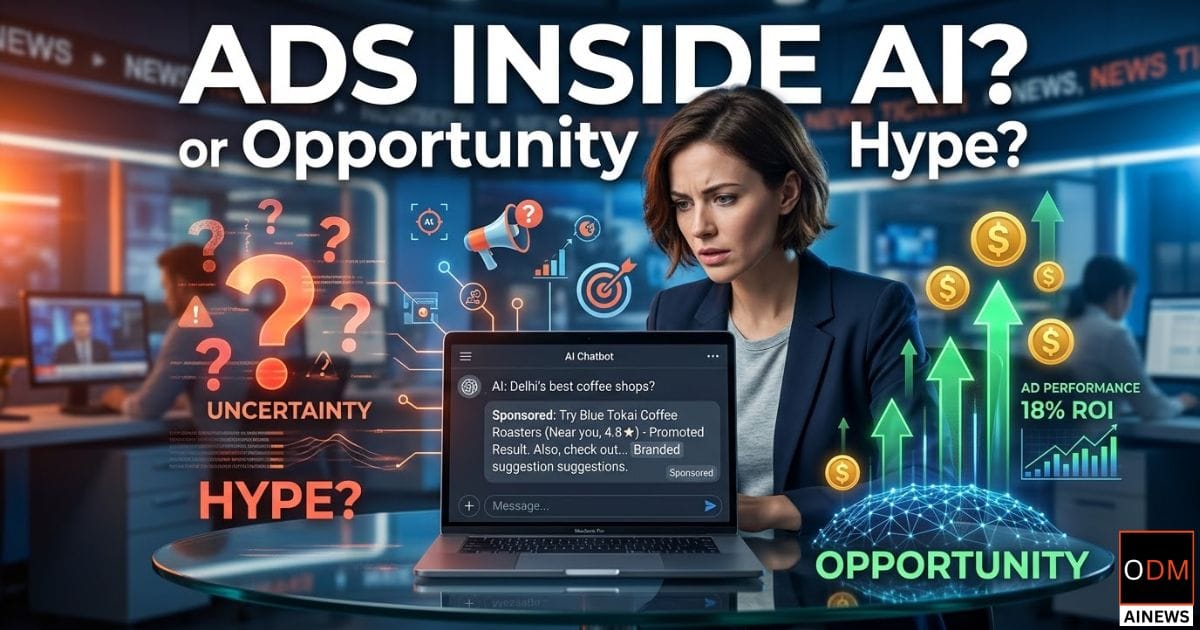
OpenAI’s implementation sits ads in clearly labelled boxes below organic responses, never inside the response text. The company states explicitly that ads do not influence answers responses are optimised for helpfulness, not advertiser relationships. That separation is both the ethical position and the commercial necessity. The moment users perceive AI responses as commercially influenced, the product loses the trust that makes it valuable.
The conversational format also changes creative requirements entirely. A banner ad or a sponsored search result is a static object. An AI-adjacent ad placement requires copy that reads naturally alongside a conversational response, that is relevant to the specific query context, and that doesn’t feel like an interruption of the answer the user came for. That is a different creative brief than anything performance marketers have written before.
Targeting Capabilities Inside AI Platforms
ChatGPT’s targeting relies on three signals: conversation topics, chat history, and previous ad interactions. If a user enables the memory feature and opts into personalised advertising, the platform can use stored memories previous queries, preferences, and stated goals when selecting which ad to show. Advertisers never receive access to individual user conversations. OpenAI provides only aggregated performance metrics, which means attribution is currently a black box.
The targeting approach differs fundamentally from auction-based systems like Google Ads and Meta Ads, where bid amounts directly affect placement and visibility. OpenAI has not confirmed whether pricing influences ad selection or whether relevance is the sole factor. That opacity is a significant practical problem for performance marketers whose entire workflow depends on understanding which inputs drive which outputs.
Google’s AI ad targeting is the most mature because it builds on existing audience and keyword infrastructure. An advertiser already running Google Search campaigns can extend into AI Overview placements through AI Max without rebuilding their targeting from scratch. That continuity is why Google’s AI advertising is the only AI-native channel most marketers should consider actively testing in 2026.
Early Results Do AI Ads Actually Convert?
The conversion data on ChatGPT specifically is not public. OpenAI’s beta is too restricted and too recent to produce third-party verified performance benchmarks. The $60 CPM entry rate approximately three times Meta’s average and significantly above Google Display Network rates implies OpenAI expects strong performance, or is simply pricing early access as a premium signal. No advertiser in the beta has published campaign-level results.
Seer Interactive’s analysis of 206,412 ChatGPT responses across 43 brands identified an algorithmic shift beginning December 1, 2025 46 days before the public advertising announcement. The organic citation environment became more structured and source-dense before paid placements arrived. The implication is that organic AI visibility is being established as the credibility layer on which paid placements will eventually sit. You need organic results to be trusted before paid units placed alongside them can work.
The closest proxy for AI ad performance is Google’s AI Overviews data, where the 14% conversion lift in AI Max campaigns is the most reliable early signal. Users arriving from AI-assisted search are more qualified than average organic visitors. The intent compression that makes AI-mediated discovery interesting for advertising is real. Whether that dynamic transfers to a standalone AI chat interface where the context is conversational rather than search remains unconfirmed.
Cost Comparison with Google and Meta Ads
The ChatGPT beta CPM of $60 is the headline number. For context: Meta’s average CPM across placements runs between $5 and $20 depending on audience and objective. Google Search CPCs vary enormously by category but average $2–$5 for most industries. Google AI Max placements don’t have a separate pricing structure they work within existing campaign budgets.
The $200,000 minimum beta commitment means ChatGPT advertising is currently a Fortune 500 conversation, not an SME or mid-market one. If OpenAI’s stated roadmap holds a self-serve tier in 2027 that will change. But in March 2026, the pricing structure excludes the majority of the global advertiser market, including most Indian brands and agencies.
Caitlin Halpert, VP of Growth at performance marketing agency Journey Further, makes the practical case plainly: “Prioritize earned media coverage and create content that deeply resonates with users, rather than merely optimizing for algorithms.” In a channel where organic citation quality is the foundation on which paid placements are being built, that is not a conservative position it is the strategically correct one for the current moment.
Should Indian Marketers Experiment Now or Wait?
Wait with specific preparation. ChatGPT advertising is currently US-only, with no confirmed international timeline. OpenAI has indicated it will expand as it learns from the initial test and matures the platform’s safeguards, but international availability has not been confirmed on a schedule. For Indian marketers, the channel is not accessible in any direct sense right now.
The indirect opportunity is real, however. 44% of users who have tried AI-powered search now call it their primary source for internet searching, according to Digital Marketing Institute research from January 2026. India’s Gemini adoption 52% of AI chatbot downloads means Indian users are disproportionately exposed to Google’s AI-integrated advertising surfaces, which are accessible today through standard Google Ads. That is where Indian advertiser attention and experimentation budget should go in 2026: Google AI Max campaigns, Google AI Overviews optimisation, and Gemini-integrated search, not ChatGPT’s closed beta.
The one preparation task that applies now is organic AI visibility. Seer Interactive’s evidence that organic citation infrastructure is being built before paid placements arrive suggests that the brands establishing strong AI citation presence today will have a structural advantage when self-serve AI advertising becomes available globally. Building that foundation is not a waiting strategy. It is the work that determines whether paid AI advertising, when accessible, will be worth anything.
Expert Opinions and Predictions
The industry split is genuinely unresolved, and serious analysts are on both sides. Perplexity’s exit from advertising and Claude’s stated refusal to run ads set up a direct trust-versus-monetisation tension that will play out in user behaviour over the next 12–18 months. If users demonstrate a strong preference for ad-free AI tools and are willing to pay for that preference OpenAI’s model faces pressure. If users are relatively indifferent to clearly labelled ads in a free product, OpenAI’s financial rationale is vindicated.
OpenAI’s expansion roadmap, if it holds, runs as follows: broader rollout to ChatGPT Search for English-speaking markets through mid-2026, sidebar sponsored content and affiliate features in Q4 2026, full international expansion and a self-serve platform in 2027. That is the optimistic case. The realistic case is slower, with each phase contingent on user trust metrics that OpenAI hasn’t disclosed.
Kantar’s 2026 data puts 24% of AI users already relying on an AI assistant to make purchasing decisions on their behalf. That behavioural adoption rate, if it continues growing, eventually makes the AI advertising question urgent regardless of current platform restrictions. The marketers building readiness now are preparing for a channel that will matter significantly within two to three years, even if it doesn’t matter much in the next six months.
How to Prepare for AI Advertising in 2026
Four specific actions apply now, regardless of when direct access to AI ad platforms becomes available.
First, track ChatGPT as a referral source in your web analytics. Even without paid placements, ChatGPT drives referral traffic for brands with strong organic AI citation presence. Knowing your current baseline makes future performance measurement meaningful.
Second, audit your brand’s current presence inside AI tools. Type your brand name and core product category into ChatGPT, Gemini, Claude, and Perplexity. Observe what they say. Inaccurate or incomplete information isn’t just an organic problem it is the foundation that paid placements will eventually build on, and a bad foundation produces bad results regardless of spend.
Third, invest in structured data and schema markup. FAQ schema, product schema, How-To schema these are the technical signals that make your content legible to AI systems evaluating what to cite. Organic AI visibility is compounding infrastructure. The time to build it is before the paid channel opens, not after.
Fourth, set aside a small test budget for Google AI Max campaigns now. This is the only AI-adjacent advertising channel with accessible entry, proven conversion lift data, and established measurement infrastructure. The learning from Google AI Max will directly transfer to other AI advertising platforms as they open. It is the most useful preparation available today.
New KPIs for AI Advertising Readiness
The metrics that matter for AI advertising readiness are different from those that measure paid search or social performance. AI Citation Rate how frequently your brand appears as a cited source in AI-generated answers for relevant queries is the leading indicator of organic AI visibility, which is the prerequisite for paid AI ad performance. Share of direct-to-site traffic via AI referral shows whether your current organic AI presence is generating measurable visits. Brand mention accuracy inside AI tools whether the information AI systems have about your brand is current, correct, and complete is the quality indicator that determines whether organic or paid AI visibility is working in your favour or against you.
These metrics aren’t standard in any analytics platform yet. Tracking them requires manual auditing of AI responses and custom segments in GA4 for AI referral sources. That is the current operational reality imperfect, but better than not measuring at all.
What This Means for You
Advertising inside AI tools 2026 is not hype. The channel is real, the intent signals are genuinely valuable, and the scale 800 million weekly ChatGPT users, 1.5 billion monthly Google AI Overview users is substantial. But for most marketers globally, and specifically for Indian advertisers, it is not a channel to buy in 2026. It is a channel to prepare for, by building the organic AI visibility foundation that paid placements will eventually amplify.
The brands that will get the most from AI advertising when it becomes broadly accessible are those that have established strong AI citation presence before the paid auction opens. That work starts with structured data, topical content authority, and entity accuracy inside AI systems none of which requires a $200,000 minimum commitment. It just requires starting now.