
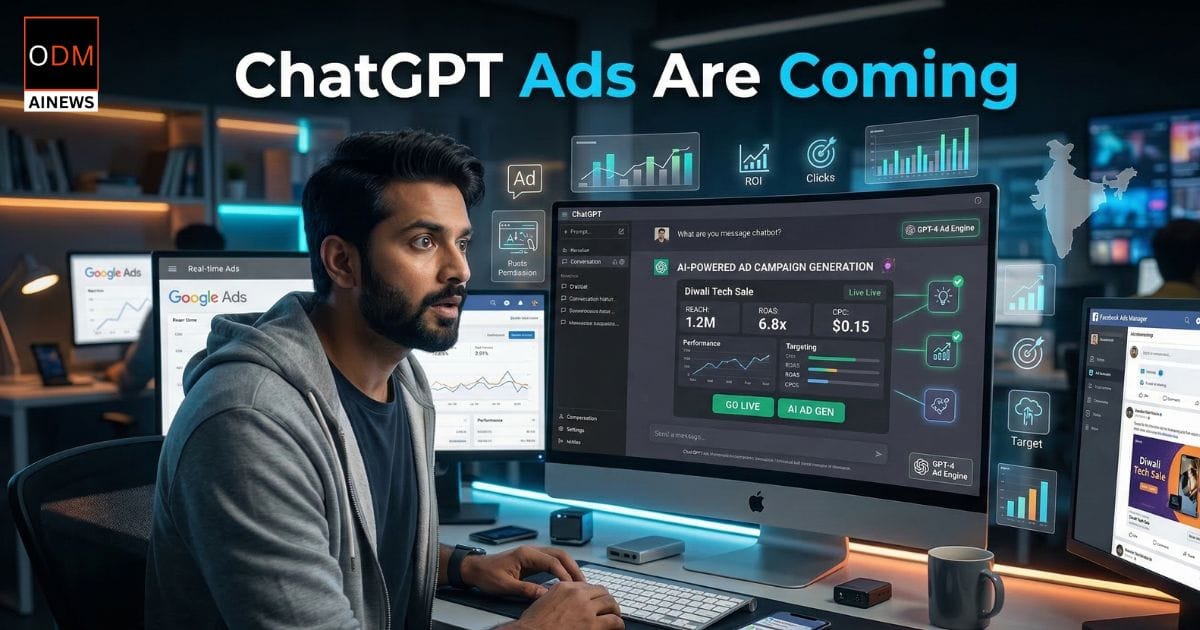
Fewer than 5% of ChatGPT’s users pay for a subscription. That single statistic explains everything you need to know about why ChatGPT ads for marketers are now real, live, and accelerating faster than most of the industry expected. On January 16, 2026, OpenAI officially confirmed what the advertising world had been speculating about for months: ChatGPT was entering the paid advertising space. By early February, the first sponsored placements were appearing inside conversations. By late February, the advertiser roster had ballooned to include some of the biggest brand names in American retail, travel, and tech. If you thought you had more time to figure this out, you didn’t.
The Brands Already in the Room
This is not vaporware. Ads from brands including Expedia, Qualcomm, Best Buy, and Enterprise Mobility have begun appearing inside ChatGPT responses, confirmed by OpenAI to several advertising publications. Target, along with its retail media division Roundel, is also among the first partner brands with sponsored, contextual ads appearing alongside users’ shopping conversations. The depth of commitment from global holding groups is equally telling. Dentsu, Omnicom, and WPP have lined up to test placements, bringing brands such as Adobe, Audemars Piguet, Audible, Ford, Mazda, and Mrs. Meyer’s into early experiments. These aren’t brands experimenting out of curiosity. They’re making calculated bets that conversational AI is the next major media surface. And the data backs them up. Aggregated insights from Criteo’s US clients show that users referred from LLM platforms like ChatGPT convert at approximately one-and-a-half times the rate of other referral channels a stat that should make every performance marketer sit up straight.
How ChatGPT Ads Actually Work
Forget everything you know about banner placements and sidebar real estate. This is a fundamentally different format. Ads appear at the bottom of ChatGPT answers when there’s a relevant sponsored product or service based on the current conversation. They are clearly labelled and separated from the organic answer OpenAI has been emphatic that sponsored content does not influence what ChatGPT actually says. The targeting mechanism is contextual, not behavioural in the traditional sense. ChatGPT decides which ad to show by matching advertiser submissions with the topic of the live conversation, factoring in past chat history and interaction signals. A user researching flight options may see an Expedia placement. Someone asking about home office setups might see a Best Buy recommendation. Think of it as intent-driven search advertising, but embedded inside a dialogue rather than displayed beside a list of blue links. The pricing reflects the premium. OpenAI has positioned personalised ad placements at a CPM significantly higher than traditional display advertising reportedly around $60 for premium inventory. More significantly, early reports suggest advertisers need to commit at least $200,000 to participate in the initial test phase. For now, this is an enterprise-first playground.
Key stat: Early analysis of ChatGPT ad placements suggests ads appear in roughly 0.8% of responses tightly controlled inventory, meaning less competition and more attention per placement during this early window.
How This Differs From Google Ads and Meta Ads
The distinctions matter enormously if you’re planning where to allocate budget. Google Search Ads intercept intent at the moment of query you type something, and the algorithm serves a paid result before the organic ones. Meta Ads work on behavioural profiling: the platform knows what you’ve liked, clicked, and scrolled past, and targets you with demographically and psychographically matched creative. ChatGPT ads are neither. They sit inside an answer. The user has already committed to a conversation, often mid-research, mid-decision. Consideration now unfolds through dialogue, not a single query. A well-matched ad in that context reaches a genuinely receptive audience someone who is actively problem-solving, not passively scrolling. That’s a uniquely high-value position. It’s also a uniquely high-risk one: a poorly matched ad inside a trusted response damages brand perception more sharply than a misfire on a social feed. There is also structural opacity to the current system. OpenAI has not revealed whether bid prices influence ad selection or if relevance remains the sole determining factor a clear difference from the auction-based mechanisms of Google and Meta, where budget directly impacts positioning. Transparency will likely improve as the platform matures, but for now, marketers are operating with less visibility than they’re accustomed to.
What This Means for Indian Digital Marketers
Here’s the uncomfortable truth: the initial launch is limited to US-based advertisers targeting US users. Direct campaign access for Indian brands or agencies isn’t available yet. So ChatGPT ads, strictly speaking, are not something you can buy from Mumbai or Bengaluru today. But that framing misses the point entirely. ChatGPT has over 700 million weekly active users globally. Indian users are already inside those conversations researching products, planning purchases, comparing brands. When OpenAI expands the programme internationally likely beginning with the UK, Canada, and Australia before moving into Asia Indian marketers who already understand the format will have a head start of months over those who waited. More immediately, the conversational AI shift is already reshaping how Indian consumers discover brands. Whether through ChatGPT, Perplexity, or Google’s AI Overviews, a meaningful portion of search behaviour is migrating to answer engines. Indian brands need to be optimising for these platforms now not just for ads, but for organic visibility within AI-generated responses. That means structured, factual, authoritative content that AI models can surface credibly. The groundwork for paid and organic AI presence is identical. Start laying it now.
“Ads in ChatGPT create a new way for brands to introduce products and services that consumers might not otherwise encounter through organic interactions alone appearing at a moment when engagement and relevance are inherently high.” Justin Wroe, Chief Commercial Officer, Omnicom Media Group
That logic applies as powerfully to a Mumbai-based D2C brand as it does to a US retailer. The geography of the ad buy may differ. The strategic preparation is the same.
Should You Advertise on ChatGPT? Pros and Cons
The honest answer right now is: not unless you’re operating at enterprise scale with significant US-market exposure. The minimum spend threshold and geographic restrictions make this inaccessible for most Indian marketers today. But the strategic calculus for when access does open is worth thinking through clearly.
The case for early participation
Intent signals inside ChatGPT conversations are among the highest-quality available in digital advertising. Users are not passively scrolling they are actively seeking answers to specific problems. Conversion data from early testers supports this. Early-mover advantage is also real: tightly controlled inventory and curated placements mean less competition and more attention per placement right now. Brands that learn the format early will write better briefs, build better creative, and negotiate better terms when the platform scales.
The risks are real too
Attribution in conversational environments is genuinely harder. A user might discover your brand in a ChatGPT conversation and convert three weeks later via direct search traditional last-click models won’t capture that. Creative requirements are demanding: messaging must feel additive to the conversation, not intrusive. And since ads do not influence the answers ChatGPT gives, you cannot buy your way into a favourable recommendation only into adjacency with one. That’s a subtler value proposition than most paid channels offer.
How to Prepare Your Brand for AI Ad Platforms
Start with your content infrastructure. AI models surface brands that are well-documented, factually consistent, and frequently cited across the web. Before thinking about buying an ad inside ChatGPT, make sure your brand would appear credibly in an organic response. That means robust product pages, third-party coverage, structured data, and clear brand positioning that AI systems can interpret and relay accurately. Build your measurement framework now. Multi-touch attribution models not last-click will be necessary to understand how ChatGPT exposure influences downstream conversion. If your analytics stack isn’t equipped to track assisted conversions across long consideration windows, fix that before you spend a rupee on AI advertising. Watch the international rollout closely. Expansion beyond the US to the UK, Canada, and Australia is expected by mid-2026, with a creator revenue-sharing programme and direct in-chat purchasing features anticipated later in the year. India will follow. The brands with campaigns ready to adapt will move first and pay less for the privilege.
The Bottom Line
ChatGPT ads for marketers represent something genuinely new not another variation on search or social, but a paid presence inside the most trusted conversational interface in the world. The early evidence is promising: high-intent users, strong conversion signals, and a format that rewards relevance over interruption. The barriers to entry are high right now, and the geographic scope is narrow. But the direction of travel is unmistakable. For Indian marketers, the immediate task isn’t to buy ads. It’s to understand the format deeply, prepare your brand for AI-driven discovery, and build the measurement infrastructure that will let you move decisively when OpenAI opens the platform internationally. The brands already running inside ChatGPT aren’t doing it because it’s cheap or easy. They’re doing it because they understand that the window to shape consumer habits on a new platform is always shorter than it looks.