
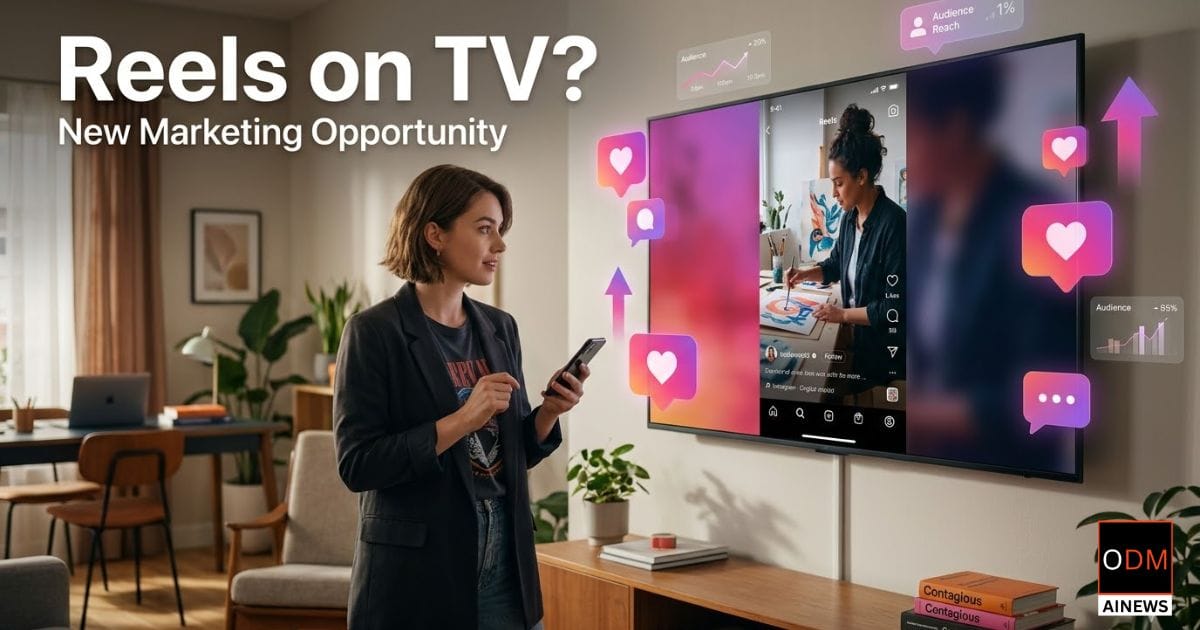
Instagram Brings Reels to the Living Room and the Rules Just Changed
YouTube captures nearly 13% of all US TV screen time in a single month. That number reported in November 2025 is what Instagram’s product team has been staring at. The Instagram Reels TV screen marketing opportunity became real in December 2025, when Meta launched Instagram for TV on Amazon Fire TV devices. By February 24, 2026, the app expanded to Google TV. The US is first. More markets are coming. And if you’re a brand or creator still thinking of Reels as a mobile format, that assumption just expired.
Instagram for TV groups Reels into channels that match user interests new music, sports highlights, hidden travel gems, trending moments giving viewers a lean-back browsing experience more like streaming than scrolling. That’s not a minor UX tweak. It’s a fundamental change in how Reels content gets consumed, and it has real consequences for anyone producing it.
How Instagram for TV Works
The app is personalized for individual users based on the content and creators they follow and engage with. Reels are grouped into channels and categories trending comedy, sports, music, lifestyle with content autoplaying once you select a channel, so viewers don’t need to keep scrolling for what comes next.
Users can add up to five accounts on one home screen, so everyone in a household can access a personalised Reels feed. Meta plans to introduce features like using your phone as a remote to browse, different ways to channel surf, and shared feeds with friends.
The architecture mirrors streaming platforms more than social feeds. Instagram likely wants viewers to switch to its TV app while watching content on the couch similar to flipping through TV channels. A viewer watching Netflix might decide they don’t want a full episode and turn to Reels instead. That is the exact behaviour Meta is designing for. It’s ambient, passive, and shared three things that mobile scrolling rarely is.
Content Format Differences: Mobile vs TV Screen
This is where most brands will get it wrong, at least initially. A vertical Reel shot on an iPhone in decent light looks fine on a 6-inch screen. On a 65-inch 4K display, every compression artefact, shaky camera movement, and low-resolution graphic becomes visible.
Visual quality that looks fine on a small phone might feel grainy or distracting on a 4K display. Sound is also mandatory on TV on mobile, many users watch with sound off, but TV viewing is an active audio experience.
The shift from portrait scrolling to landscape lean-back also changes pacing. Quick-cut content that works in a 9-second phone Reel can feel disorienting on a television. Content that breathes slightly slower editing, cleaner framing, more deliberate composition performs better in the living room environment. You don’t need to abandon vertical format. You need to produce it to a standard that survives the bigger screen.
Which Brands Will Benefit Most
Not every category benefits equally from this shift. The ones with the most immediate upside are those where the purchase decision involves aspiration, visual appeal, or shared family consideration.
Travel is an obvious winner. A 60-second Reel of a Rajasthan hotel property, a Kerala houseboat at sunset, or a Leh road trip on a 55-inch screen in a family living room functions more like a travel documentary than a social post. Food and beverage brands, home décor, automotive, consumer electronics, and fashion all benefit from the same logic: the product looks better at scale, and the viewing context is more considered than a phone thumb-scroll.
B2B and service brands have a harder path here. A Reel explaining software features or a founder talking about company culture doesn’t benefit from the big screen the way a landscape destination shot does. That’s a real limitation, and worth acknowledging.
Early Mover Advantage What to Do Now
TV advertising has long been the most influential form of promotion, and marketers are now getting more opportunities for TV-like exposure and reach through social apps. The brands that move first on Instagram for TV will build audience and algorithmic history before the format gets crowded.
Tessa Lyons-Laing, VP of Product at Instagram, said at the December 2025 launch: “We have seen a ton of demand from people on Instagram to watch Reels on TV. We hear all the time that people get together with their friends to watch Reels.” The demand is real. The inventory of quality, TV-ready Reels content from brands is not yet. That gap is the window.
The strategic move right now is to audit your existing Reels library for TV suitability, identify your top 10 performing Reels, and assess whether they hold up visually at larger sizes. Start producing at least a portion of your new Reels content to TV-grade visual and audio standards. You’re not replacing your mobile strategy. You’re extending it.
Creating Reels Optimised for Big Screens
Three things matter most when producing for TV viewership. First, shoot in the highest resolution available 4K if your equipment supports it, 1080p minimum. Avoid excessive digital zoom; it degrades at large sizes. Second, treat audio as a primary element, not an afterthought. On mobile, captions carry a lot of weight. On TV, the audio needs to stand alone. Record in a quiet space, use a decent microphone, and mix the final audio before posting. Third, use clean typography. Small captions that are readable on a phone screen become unreadable on a TV viewed from across a room if the font is thin or the contrast is weak. Use large, bold, high-contrast text for any on-screen graphics.
The vertical format stays. Instagram for TV plays Reels in their native vertical aspect ratio. You’re not reformatting for landscape. You’re upgrading quality within the existing format.
Monetisation Opportunities for Creators
Direct platform monetisation from Instagram for TV isn’t live yet in its full form. Meta is testing ad-based monetisation features that place image and video ads in profile feeds and Reels, inviting select creators to enable ads and start earning revenue. As TV viewing scales, this inventory becomes significantly more valuable CTV ad rates historically command premium CPMs compared to mobile placements.
For creators not on the invite list for platform ads, the TV expansion changes the brand deal conversation. A creator who can demonstrate TV-grade Reels content and growing CTV viewership numbers has a materially stronger pitch to advertisers than one optimising only for mobile feeds. Document your production standards. Show brands that your content holds up on the big screen. That differentiation has real commercial value right now, before it becomes table stakes.
India Which Categories Benefit Most
India has over 650 million active Instagram users by 2026. The Instagram for TV rollout is currently US-only, but Meta’s track record suggests international expansion follows within two to four quarters of a US feature stabilising. India is not a secondary market for Meta it’s the largest by user volume, and the infrastructure for connected TV is growing fast, driven by Jio and affordable smart TV adoption across Tier 1 and Tier 2 cities.
The categories with the highest upside for Indian brands when the TV app reaches this market are: travel and hospitality (India’s domestic tourism market is enormous and deeply visual), food and regional cuisine content (family viewing context suits food Reels well), matrimonial and lifestyle services (shared household decision-making makes TV placement more relevant than individual mobile targeting), and entertainment and OTT promotion (Reels already function as trailers on TV screens, that function is even stronger).
Finance and edtech brands face the same limitations here as globally the format doesn’t naturally suit complex information on a lean-back screen. Those categories are better served by LinkedIn and YouTube long-form.
Action Plan for Brands and Creators
The first step is simple: download Instagram for TV on an Amazon Fire TV or Google TV device today and experience what your content actually looks like on a large screen. Most marketers haven’t done this. Those who have tend to immediately understand what needs to change in their production approach.
Week one: audit your Reels library on a TV screen. Identify what passes and what doesn’t. Week two: brief your content production team on TV-grade quality standards resolution, audio, typography. Week three: produce two to three Reels specifically built with TV viewing in mind, and monitor watch-time data on Instagram to see whether they outperform previous content in completion rates. Week four: document your CTV-ready content in your media kit if you’re a creator, or in your brand’s marketing capabilities deck if you’re an advertiser.
The India-specific action is to start this process now, before the app launches in this market. Brands that arrive at the India launch of Instagram for TV with a backlog of TV-grade content will own the first wave of that inventory. That advantage evaporates once everyone catches up.
What This Means for You
The Instagram Reels TV screen marketing opportunity isn’t coming it arrived in December 2025. The US is the test bed. India, and the rest of Meta’s major markets, are next. Over time, Reels should add to the endlessly growing ways for people to spend their TV time, hiking the pressure on Netflix, ESPN, and others to expand into shorter formats, as Wolfe Research analyst Peter Supino noted in a December 2025 investor note.
The brands and creators who treat this as a mobile format migrating to a bigger screen will produce mediocre content and get mediocre results. The ones who understand that the living room is a fundamentally different context shared, audio-on, visually demanding will produce content that actually belongs there. That’s the real opportunity, and it’s still early.